Question
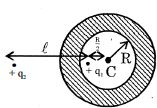
A solid conducting sphere has cavity, as shown in figure. A charge $+ {q_1}$ is situated away from the centre. A charge $+q_2$ is situated outside the sphere then true statement is
Answer

Net force on charge $+q_2$ due to induced charge on inner surface of sphere and charge $+q_1$, is 'zero'.

Need a full question paper?

Generate a complete, print-ready paper with questions like this in minutes — across 16+ boards, with answer keys.
Start Generating Free

Similar questions

Predict the major product of the following reaction sequence
A spherical ball of mass $20\, kg$ is stationary at the top of a hill of height $100 \,m$. It slides down a smooth surface to the ground, then climbs up another hill of height $30 \,m$ and finally slides down to a horizontal base at a height of $20 \,m$ above the ground. The velocity attained by the ball is ............... $\mathrm{m} / \mathrm{s}$
A system has basic dimensions as density $[D]$, velocity $[V]$ and area $[A]$. The dimensional representation of force in this system is 
Vector product of two vectors $2\hat i\, + \,\hat j\,$ and $\hat i\, + \,2\hat j\,$ is
A body initially at rest and sliding along a frictionless track from a height $h$ (as shown in the figure) just completes a vertical circle of diameter $AB =D$ . The height $h$ is equal to 
The wavelength of yellow line of sodium is $5896 Å$. Its wave number will be
Given below are two statements :

Statements $I$ : Astronomical unit $(Au)$. Parsec $(Pc)$ and Light year $(ly)$ are units for measuring astronomical distances.

Statements $II:$ $Au < Parsec ( Pc ) < ly$

In the light of the above statements. choose the most appropriate answer from the options given below:

A drop of water of volume $0.05\, cm^3$ is pressed between two glass plates, as a consequence of which it spreads and occupies an area of $40\, cm^2$. If the surface tension of water is $70\, dyne/cm$, then the normal force required to separate out the two glass plates will be in Newton
As a result of interference of two coherent sources of light, energy is
A diatomic ideal gas is compressed adiabatically to $\frac{1}{32}$ of its initial volume. If the initial temperature of the gas is $T_1$ (in Kelvin) and the final temperature is $a T_1$, the value of $a$ is