MCQ
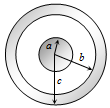
A solid conducting sphere of radius a has a net positive charge 2Q. A conducting spherical shell of inner radius b and outer radius c is concentric with the solid sphere and has a net charge – Q. The surface charge density on the inner and outer surfaces of the spherical shell will be
  • $-\frac{2 Q}{4 \pi b^2}, \frac{Q}{4 \pi c^2}$
  • B
    $-\frac{Q}{4 \pi b^2}, \frac{Q}{4 \pi c^2}$
  • C
    0, $\frac{Q}{4 \pi c^2}$
  • D
    None of the above

Answer

Correct option: A.
$-\frac{2 Q}{4 \pi b^2}, \frac{Q}{4 \pi c^2}$
(a) $-\frac{2 Q}{4 \pi b^2}, \frac{Q}{4 \pi c^2}$

Need a full question paper?

Generate a complete, print-ready paper with questions like this in minutes — across 16+ boards, with answer keys.

Start Generating Free

Similar questions

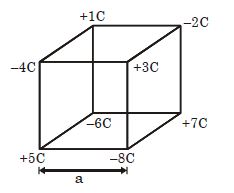
The electric flux passing through the cube for the given arrangement of charges placed at the corners of the cube (as shown in the figure) is 
The formula for induced e.m.f. in a coil due to change in magnetic flux through the coil is (here A = area of the coil, B = magnetic field)
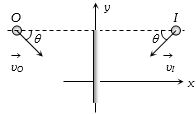
If an object moves towards a plane mirror with a speed $v$ at an angle $\theta $ to the perpendicular to the plane of the mirror, find the relative velocity between the object and the image
At a certain place, the horizontal component $B_0$ and the vertical component $V_0$ of the earth's magnetic field are equal in magnitude. The total intensity at the place will be
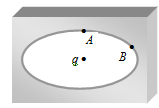
An ellipsoidal cavity is carved within a perfect conductor. A positive charge q is placed at the centre of the cavity. The points A and B are on the cavity surface as shown in the figure. Then
Faraday’s $2^{nd}$ law states that mass deposited on the electrode is directly proportional to
The total charge induced in a conducting loop when it is moved in magnetic field depend on
In Young's double slit experiment, the intensity on the screen at a point where path difference is l is K. What will be the intensity at the point where path difference is λ/4 
Electric field strength due to a point charge of 5μC at a distance of 80 cm from the charge is
The work functions of metals $A$ and $B$ are in the ratio $1 : 2$. If light of frequencies $f$ and $2f$ are incident on the surfaces of $A$ and $B$ respectively, the ratio of the maximum kinetic energies of photoelectrons emitted is (f is greater than threshold frequency of $A, 2f$ is greater than threshold frequency of $B$)