MCQ
A solid copper sphere (density $\rho $ and specific heat capacity $c$ ) of radius $r$ at an initial temperature $200K$ is suspended inside a chamber whose walls are at almost $0K$ . The time required (in $\mu s$) for the temperature of the sphere to drop to $100\, K$  is
  • A
    $\frac{{72}}{7}\frac{{r\rho c}}{\sigma }$
  • $\frac{7}{{72}}\frac{{r\rho c}}{\sigma }$
  • C
    $\frac{{27}}{7}\frac{{r\rho c}}{\sigma }$
  • D
    $\frac{7}{{27}}\frac{{r\rho c}}{\sigma }$

Answer

Correct option: B.
$\frac{7}{{72}}\frac{{r\rho c}}{\sigma }$
b
(b) $\frac{{dT}}{{dt}} = \frac{{\sigma \,A}}{{mcJ}}\,\,({T^4} - T_0^4)$ [In the given problem fall in temperature of body $dT = (200 - 100) = 100K$, temp. of surrounding $T0 = 0K$ , Initial temperature of body $T = 200K].$

$\frac{{100}}{{dt}} = \frac{{\sigma 4\pi {r^2}}}{{\frac{4}{3}\pi {r^3}\rho \,c\,J}}({200^4} - {0^4})$

==> $dt = \frac{{r\rho \,c\,J}}{{48\sigma }} \times {10^{ - 6}}s = \frac{{r\rho \,c}}{\sigma }.\frac{{4.2}}{{48}} \times {10^{ - 6}}$

$ = \frac{7}{{80}}\frac{{r\rho \,c}}{\sigma }\mu \,s\tilde --\frac{7}{{72}}\frac{{r\rho \,c}}{\sigma }\mu \,s$ [As $J = 4.2$ ]

Need a full question paper?

Generate a complete, print-ready paper with questions like this in minutes — across 16+ boards, with answer keys.

Start Generating Free

Similar questions

If the measurement errors in all the independent quantities are known, then it is possible to determine the error in any dependent quantity. This is done by the use of series expansion and truncating the expansion at the first power of the error. For example, consider the relation $z=x / y$. If the errors in $x, y$ and $z$ are $\Delta x, \Delta y$ and $\Delta z$, respectively, then

$\mathrm{z} \pm \Delta \mathrm{z}=\frac{\mathrm{x} \pm \Delta \mathrm{x}}{\mathrm{y} \pm \Delta \mathrm{y}}=\frac{\mathrm{x}}{\mathrm{y}}\left(1 \pm \frac{\Delta \mathrm{x}}{\mathrm{x}}\right)\left(1 \pm \frac{\Delta \mathrm{y}}{\mathrm{y}}\right)^{-1} .$

The series expansion for $\left(1 \pm \frac{\Delta y}{y}\right)^{-1}$, to first power in $\Delta y / y$, is $1 \mp(\Delta y / y)$. The relative errors in independent variables are always added. So the error in $\mathrm{z}$ will be $\Delta \mathrm{z}=\mathrm{z}\left(\frac{\Delta \mathrm{x}}{\mathrm{x}}+\frac{\Delta \mathrm{y}}{\mathrm{y}}\right)$.

The above derivation makes the assumption that $\Delta x / x<<1, \Delta \mathrm{y} / \mathrm{y} \ll<1$. Therefore, the higher powers of these quantities are neglected.

($1$) Consider the ratio $\mathrm{r}=\frac{(1-\mathrm{a})}{(1+\mathrm{a})}$ to be determined by measuring a dimensionless quantity a.

If the error in the measurement of $\mathrm{a}$ is $\Delta \mathrm{a}(\Delta \mathrm{a} / \mathrm{a} \ll<1)$, then what is the error $\Delta \mathrm{r}$ in

$(A)$ $\frac{\Delta \mathrm{a}}{(1+\mathrm{a})^2}$ $(B)$ $\frac{2 \Delta \mathrm{a}}{(1+\mathrm{a})^2}$ $(C)$ $\frac{2 \Delta \mathrm{a}}{\left(1-\mathrm{a}^2\right)}$ $(D)$ $\frac{2 \mathrm{a} \Delta \mathrm{a}}{\left(1-\mathrm{a}^2\right)}$

($2$) In an experiment the initial number of radioactive nuclei is $3000$ . It is found that $1000 \pm$ $40$ nuclei decayed in the first $1.0 \mathrm{~s}$. For $|\mathrm{x}| \ll 1$, In $(1+\mathrm{x})=\mathrm{x}$ up to first power in $x$. The error $\Delta \lambda$, in the determination of the decay constant $\lambda$, in $\mathrm{s}^{-1}$, is

$(A) 0.04$    $(B) 0.03$    $(C) 0.02$   $(D) 0.01$

Give the answer quetion ($1$) and ($2$)
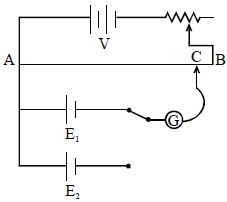
The circuit shown here is used to compare the emf of two cells $E_1$ and $E_2 (E_1 > E_2)$. The null point is at $C$ when the galvanometer is connected to $E_1$. When the galvanometer is connected to $E_2$, the null point will be
A source and an observer move away from each other with a velocity of $10\; m/s$ with respect to ground. If the observer finds the frequency of sound coming from the source as $1950 \;Hz$, then actual frequency of the source is .... $Hz$ (velocity of sound in air = $340\; m/s$)
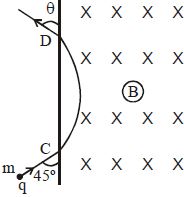
A particle of mass $m = 1.67 \times 10^{-27}\, kg$ and charge $q = 1.6 \times 10^{-19} \, C$ enters a region of uniform magnetic field of strength $1$ $tesla$ along the direction shown in the figure. the time spent by the particle in the magnetic field is......$ns$
A glass flask contains some mercury at room temperature. It is found that at different temperatures the volume of air inside the flask remains the same. If the volume of mercury in the flask is $300 \,\,cm^3$, then volume of the flask is ........ $cm^3$. (given that coefficient of volume expansion of mercury and coefficient of linear expansion of glass are $1.8 × 10^{-4} (^o C)^{-1}$ and $9 × 10^{-6} (^o C)^{-1}$ respectively)
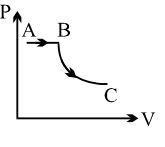
A process is shown in the diagram. Which of the following curves may represent the same process ?
The weight of an astronaut, in an artificial satellite revolving around the earth, is
A triode has a plate resistance of $10 k \Omega$ and amplification factor $24$. If the input signal voltage is $0.4\, V$ $(r.m.s.)$, and the load resistance is $10\, k$ ohm, then, the output voltage $(r.m.s.)$ is......$V$
At time $t =0$ a particle starts travelling from a height $7\,\hat{z} cm$ in a plane keeping $z$ coordinate constant. At any instant of time it's position along the $x$ and $y$ directions are defined as $3\,t$ and $5\,t^{3}$ respectively. At $t =1\,s$ acceleration of the particle will be.
Out of the following, which one is not emitted by a natural radioactive substance?