MCQ
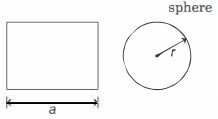
A solid cube and a solid sphere both made of same material are completely submerged in water but to different depths. The sphere and the cube have same surface area. The buoyant force is
  • A
    greater for the cube than the sphere
  • greater for the sphere than the cube
  • C
    same for the sphere and the cube
  • D
    greater for the object that is submerged deeper

Answer

Correct option: B.
greater for the sphere than the cube
b
(b)

Given,

Surface area of cube $=$ Surface area of sphere

$\Rightarrow 6 a^2 =4 \pi r^2 \dots(i)$

$\Rightarrow \frac{a}{r}=\sqrt{\left(\frac{4 \pi}{6}\right)}=\sqrt{\frac{2 \pi}{3}}$

Now, buoyant force is $F_B=V_{\text {in }} \cdot \rho_f . g$ So, ratio of buoyant force on cube and sphere is

$\frac{\left(F_B\right)_{\text {cube }}}{\left(F_B\right)_{\text {sphere }}}=\frac{V_{\text {cube }}}{V_{\text {sphere }}}$

$=\frac{a^3}{\frac{4}{3} \pi r^3}=\frac{3}{4 \pi} \times\left(\frac{2 \pi}{3}\right)^{\frac{3}{2}}$

$=\sqrt{\frac{9}{16 \times \pi^2} \times 27}=\sqrt{\frac{\pi}{6}}$

$\therefore \left(F_B\right)_{\text {cube }} < \left(F_B\right)_{\text {sphere }}$
Need a full question paper?

Generate a complete, print-ready paper with questions like this in minutes — across 16+ boards, with answer keys.

Start Generating Free

Similar questions

The motion of a simple pendulum excuting $S.H.M$. is represented by following equation.

$Y = A \sin (\pi t +\phi)$, where time is measured in $second$.

The length of pendulum is .............$cm$

A hydrogen atom (ionisation potential $ 13.6\, eV$) makes a transition from third excited state to first excited state. The energy of the photon emitted in the process is.......$eV$
In an hour-glass approximately $100$ grains of sand fall per second (starting from rest); and it takes $2 \, s$ for each sand particle to reach the bottom of the hour-glass. If the average mass of each sand particle is $0.2 \,g$, then the average force exerted by the falling sand on the bottom of the hour-glass is close to .......... $N$
The ratio of radii of two wires of same material is $2: 1$. If these wires are stretched by equal force, the ratio of stresses produced in them is $.............$
In a region of uniform magnetic induction $B = {10^{ - 2}}\,tesla$, a circular coil of radius $30\, cm$ and resistance $\pi^2 \;ohm$ is rotated about an axis which is perpendicular to the direction of $B$ and which forms a diameter of the coil. If the coil rotates at  $200\, rpm$ the amplitude of the alternating current induced in the coil is.....$mA$
On adjusting the $P-N $junction diode in forward biased
A passenger train of length $60\, m$ travels at a speed of $80\, km/hr$. Another freight train of length $120\, m$ travels at a speed of $30\, km/hr$. The ratio of times taken by the passenger train to completely cross the freight train when:

$(i)$ they are moving in the same direction, and

$(ii)$ in the opposite directions is

The superposing waves are represented by the following equations :${y_1} = 5\sin 2\pi (10\,t - 0.1x)$, ${y_2} = 10\sin 2\pi (20\,t - 0.2x)$ Ratio of intensities $\frac{{{I_{\max }}}}{{{I_{\min }}}}$ will be
Choose the correct statement for processes $A$  & $B$ shown in figure.
When light of a given wavelength is incident on a metallic surface, the minimum potential needed to stop the emitted photoelectrons is $6.0 V$. This potential drops to $0.6 V$ if another source with wavelength four times that of the first one and intensity half of the first one is used. What are the wavelength of the first source and the work function of the metal, respectively? $\left[\right.$ Take $\left.=\frac{h c}{c}=1.24 \times 10^{-6} Jm ^{-1}.\right]$