MCQ
A solid cube and a solid sphere of the same material have equal surface area. Both are at the same temperature ${120^o}C$, then
  • A
    Both the cube and the sphere cool down at the same rate
  • The cube cools down faster than the sphere
  • C
    The sphere cools down faster than the cube
  • D
    Whichever is having more mass will cool down faster
Answer

Correct option: B.
The cube cools down faster than the sphere
b
(b)Rate of cooling of a body $R = \frac{{\Delta \theta }}{t} = \frac{{A\varepsilon \sigma ({T^4} - T_0^4)}}{{mc}}$
==> $R \propto \frac{A}{m} \propto \frac{{{\rm{Area}}}}{{{\rm{Volume}}}}$

==> For the same surface area. $R \propto \frac{1}{{{\rm{Volume}}}}$
( Volume of cube < Volume of sphere

==> ${R_{Cube}} > {R_{Sphere}}$ i.e. cube, cools down with faster rate.

Need a full question paper?

Generate a complete, print-ready paper with questions like this in minutes — across 16+ boards, with answer keys.

Start Generating Free

Similar questions

Statement $I :$ A cyclist is moving on an unbanked road with a speed of $7\, kmh ^{-1}$ and takes a sharp circular turn along a path of radius of $2 \,m$ without reducing the speed. The static friction coefficient is $0.2$ . The cyclist will not slip and pass the curve $\left( g =9.8\, m / s ^{2}\right)$

Statement $II :$ If the road is banked at an angle of $45^{\circ}$, cyclist can cross the curve of $2\, m$ radius with the speed of $18.5\, kmh ^{-1}$ without slipping.

In the light of the above statements, choose the correct answer from the options given below.

A metallic rod of length $20 \,cm$ is palced in NorthSouth direction and is moved at a constant speed of $20 \,m / s$ towards East. The horizontal component of the Earth's magnetic field at that place is $4 \times 10^{-3} \,T$ and the angle of dip is $45^{\circ}$. The emf induced in the rod is ............. $mV$.
Consider the following statements in case of Young's double slit experiment 
$(1)$ A slit is necessary if we use an ordinary extended source of light
$(2)$ A slit is not necessary if we use an ordinary but well collimated beam of light
$(3)$ A slit is not needed if we use a spatially coherent point source of light
Which of the above statements is true ?
If a satellite of mass $400 \,kg$ revolves around the earth in an orbit with speed $200 \,m / s$ then its potential energy is .......... $MJ$
Which does not has the same unit as others
The region between $y = 0$ and $y = d$ contains a magnetic field $\vec B = B\hat z$ A particle of mass $m$ and charge $q$ enters the region with a velocity $\vec v = v\hat i$. If $d = \frac{{mv}}{{2qB}}$ , the acceleration of the charged particle at the point of its emergence at the other side is
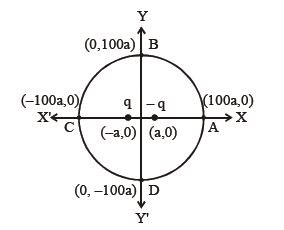
An electric dipole is placed on the $x-$axis as shown in the figure. Consider a spherical closed surface around it. Then 
The rate of radiation of a black body at $0°C$ is $E\,J/sec$ . The rate of radiation of this black body at ${273^o}C$ will be
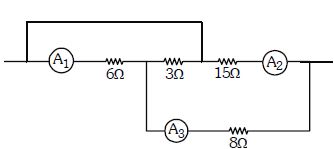
A part of circuit is shown in figure. All the ammeters are ideal. If reading of ammeter $A_1$ is $1.0\ A$ , then
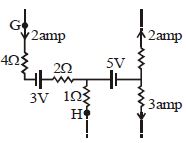
In the part of a circuit shown in the figure, the potential difference $(V_G -V_H)$ between points $G$ and $H$ will be ............... $V$