MCQ
A solid cube is first floating in a liquid. The coefficient of linear expansion of cube is $\alpha$ and the coefficient of volume expansion of liquid is $\gamma$. On increasing the temperature of (liquid + cube) system, the cube will sink if

  • A
    $\gamma=3 \alpha$
  • $\gamma > 3 \alpha$
  • C
    $\gamma < 3 \alpha$
  • D
    $\gamma=2 \alpha$

Answer

Correct option: B.
$\gamma > 3 \alpha$
b
(b)

Cube will sink if expansion in liquid upon heating is more than that of cube or $3 \alpha < \gamma$

Need a full question paper?

Generate a complete, print-ready paper with questions like this in minutes — across 16+ boards, with answer keys.

Start Generating Free

Similar questions

A spherical body of mass $m$ and radius $r$ is allowed to fall in a medium of viscosity $\eta $. The time in which the velocity of the body increases from zero to $0.63$ times the terminal velocity $(v)$ is called time constant $(\tau )$. Dimensionally $\tau $ can be represented by
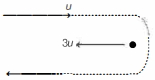
A spacecraft which is moving with a speed $u$ relative to the earth in the $x$-direction, enters the gravitational field of a much more massive planet which is moving with a speed $3 \,u$ in the negative $x$-direction. The spacecraft exits following the trajectory as shown below. The speed of the spacecraft with respect to the earth a long a time after it has escaped the planet's gravity is given by
A sine wave of wavelength $\lambda $ is travelling in a medium. The minimum distance between the two particles, always having same speed, is
Two simple pendulums of length $0.5\, m$ and $2.0\, m$ respectively are given small linear displacement in one direction at the same time. They will again be in the phase when the pendulum of shorter length has completed .... oscillations.
The acceleration of a body due to the attraction of the earth (radius $R$) at a distance $2 \,R$ from the surface of the earth is ($g =$ acceleration due to gravity at the surface of the earth)
The number of particles crossing per unit area perpendicular to X-axis in unit time is:
$\text{N}=-\text{D}\frac{\text{n}_2-\text{n}_1}{\text{x}_2-\text{x}_1}$
Where n1 and n2 are number of particles per unit volume for the value of x1 and x2 respectively. The dimensions of diffusion constant D are:
If work done in increasing the size of a soap film from $10\;cm \times 6\;cm$ to $10\;cm \times 11\;cm$ is $2 \times {10^{ - 4}}\,J,$ then the surface tension is
If a liquid takes $30 \;sec$ in cooling from $80^{\circ} C$ to $70^{\circ} C$ and $70 \;sec$ in cooling from $60^{\circ} C$ to $50^{\circ} C$, then find the room temperature.
A car moving on a horizontal road may be thrown out of the road in taking a turn
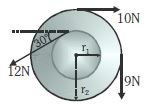
In the following figure $r_1$ and $r_2$ are $5\, cm$ and $30\, cm$ respectively. If the moment of inertia of the wheel is $5100\, kg-m^2$ then its angular acceleration will be