Question
A solid cylinder has a total surface area of $462\ cm^2$. Its curved surface area is one-third of its total surface area. Find the radius and height of the cylinder.

Answer

Given that Curved or lateral surface area $= 13 \times $ total surface area
$2\pi\text{rh}=\frac{1}{3}(2\pi\text{rh}+2\pi\text{r}^2)$
$4\pi\text{rh}=2\pi\text{r}^2$
$2\text{h}=\text{r}$ Total surface area $= 462cm^2$
Curved surface area $=\frac{1}{3}\times462$
$2\pi\text{rh}=154$
$2\times3.14\times2\times\text{h}^2=154$
$\text{h}^2=\frac{49}{4}$
$\text{h}=\frac{49}{4}\text{cm}$
$=\frac{7}{2}\text{cm}$
Now $r = 2h$
Therefore $\text{r}=2\times\text{7}{2}\text{cm}=7\text{cm}$
The height and the radius of the cylinder is $\frac{7}{2}\text{cm}$ and $7cm$ respectively.

Need a full question paper?

Generate a complete, print-ready paper with questions like this in minutes — across 16+ boards, with answer keys.
Start Generating Free

Similar questions

If $\text{a}=3-2\sqrt{2},$ find the value of $\text{a}^2-\frac{1}{\text{a}^2}.$
Monica has a piece of Canvas whose area is$ 551\ m^2$. She uses it to have a conical tent made, with a base radius of $7\ m.$ Assuming that all the stitching margins and wastage incurred while cutting amounts to approximately $1\ m^2​​​​​​​$​​​​​​​. Find the volume of the tent that can be made with it.
A classroom is $10\ m$ long, $6.4\ m$ wide and $5\ m$ high. If each student be given $1.6\ m^2$ of the floor area, how many students can be accommodated in the room? How many cubic metres of air would each student get?
Using factor theorem, factorize the following polynomials: $y^3 - 2y^2 - 29y - 42$
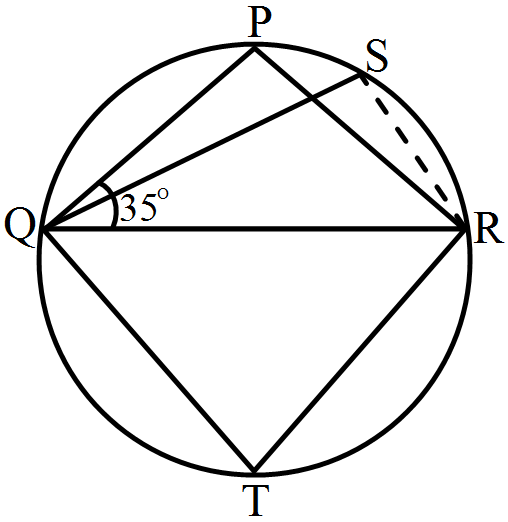
In the given figure, $\triangle\text{PQR}$ is an isosceles triangle with $PQ = PR$ and $\text{m}\angle\text{PQR}=35^\circ.$ Find $\text{m}\angle\text{QSR}$ and $\text{m}\angle\text{QTR}.$
$ABCD$ is a square $E, F, G$ and $H$ are points on $AB, BC, CD,$ and $DA$ respectively, such that $AE = BF = DH$. prove that $EFGH$ is a square.
$ABCD$ is a trapezium in which $AB || DC, DC = 30\ cm$ and $AB = 50\ cm.$ If $X$ and $Y$ are, respectively the mid-points of $AD$ and $BC,$ prove that $\text{ar}(\text{DCYX})=\frac{7}{9}\ \text{ar}(\text{XYBA})$
Simplify $\frac{\sqrt{13}-\sqrt{11}}{\sqrt{13}+\sqrt{11}}+\frac{\sqrt{13}+\sqrt{11}}{\sqrt{13}-\sqrt{11}}$
If $\text{x}^2+\frac{1}{\text{x}^2}=98,$ find the value of $\text{x}^3+\frac{1}{\text{x}^3}.$