MCQ
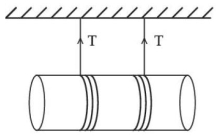
A solid cylinder length is suspended symmetrically through two massless strings, as shown in the figure. The distance from the initial rest position, the cylinder should by unbinding the strings to achieve a speed of $4\,ms ^{-1}$, is$........cm$. $\left(\right.$ take $\left.g=10\,ms ^{-2}\right)$
  • A
    $60$
  • B
    $30$
  • $120$
  • D
    $150$

Answer

Correct option: C.
$120$
c
From energy conservation

$mgh =\frac{1}{2} m v^{2}+\frac{1}{2} I ^{2}$

$mgh =\frac{1}{2} mv ^{2}+\frac{1}{2} \frac{ mR ^{2}}{2} \omega^{2}$

$10\,h =\frac{16}{2}+\frac{16}{4} \Rightarrow h =1.2\,m =120\,cm$

Need a full question paper?

Generate a complete, print-ready paper with questions like this in minutes — across 16+ boards, with answer keys.

Start Generating Free

Similar questions

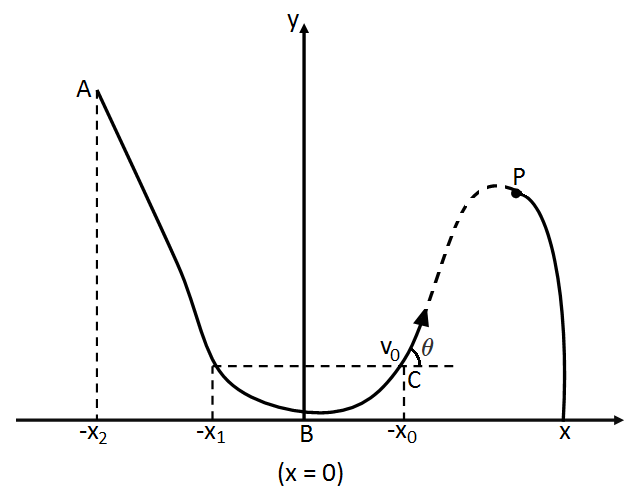
A particle slides down a frictionless parabolic (y = x) track (A – B – C) starting from rest at point A. Point B is at the vertex of parabola and point C is at a height less than that of point A. After C, the particle moves freely in air as a projectile. If the particle reaches highest point at P, then

  1. KE at P = KE at B.
  2. height at P = height at A.
  3. total energy at P = total energy at A.
  4. time of travel from A to B = time of travel from B to P.
Two point masses of $0.3\ kg$ and $0.7\ kg$ are fixed at the ends of a rod of length $1.4\ m$  and of negligible mass. The rod is set rotating about an axis perpendicular  to its length with a uniform angular speed. The point on the rod through which the axis should pass in order that the work required for rotation of the rod is minimum is located at a distance of  
In steel, the Young's modulus and the strain at the breaking point are $2 \times {10^{11}}\,N{m^{ - 2}}$ and $0.15$ respectively. The stress at the breaking point for steel is therefore
A body has speed $V, 2V$ and $3V$ in first $1/3$ of distance $S$, seconds $1/3$ of $S$ and third $1/3$ of $S$ respectively. Its average speed will be
A vehicle with a horn of frequency $n$ is moving with a velocity of $30\, m/s$ in a direction perpendicular to the straight line joining the observer and the vehicle. The observer perceives the sound to have a frequency $n + {n_1}$. Then (if the sound velocity in air is $300\, m/s$)
The radius of a circle is stated as 2.12cm. Its area should be written as:
  1. 14cm2.
  2. 14.1cm2.
  3. 14.11cm2.
  4. 14.1124cm2.
A cart moves with a constant speed along a horizontal circular path. From the cart, a particle is thrown up vertically with respect to the cart, the particle will,
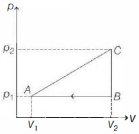
An ideal gas with constant heat capacity $C_V=\frac{3}{2} n R$ is made to carry out a cycle that is depicted by a triangle in the figure given below. The following statement is true about the cycle.
A ball rolls off the top of a stairway with horizontal velocity $\mathrm{u}$. The steps are $0.1 \mathrm{~m}$ high and $0.1 \mathrm{~m}$ wide. The minimum velocity $\mathrm{u}$ with which that ball just hits the step $5$ of the stairway will be $\sqrt{\mathrm{x}} \mathrm{ms}^{-1}$ where $\mathrm{x}=$___________ [use $\mathrm{g}=10 \mathrm{~m} / \mathrm{s}^2$ ].
The particles $A$ and $B$ of mass $m$ each are separated by a distance $r$. Another particle $C$ of mass $M$ is placed at the midpoint of $A$ and $B$. Find the work done in taking $C$ to a point equidistant $r$ from $A$ and $B$ without acceleration $(G=$ Gravitational constant and only gravitational interaction between $A, B$ and $C$ is considered)