MCQ
A solid cylinder of mass $2\ kg$ and radius $0.2\,m$ is rotating about its own axis without friction with angular velocity $3\,rad/s$. A particle of mass $0.5\ kg$ and moving with a velocity $5\ m/s$ strikes the cylinder and sticks to it as shown in figure. The angular momentum of the cylinder before collision will be ........ $J-s$
  • $0.12$
  • B
    $12$
  • C
    $1.2$
  • D
    $ 1.12$

Answer

Correct option: A.
$0.12$
a
Angular momentum of the cylinder before collision $L = I\omega  = \frac{1}{2}M{R^2}\omega $

$ = \frac{1}{2}(2)\,{(0.2)^2} \times 3$ = $0.12\ J-s$.

Need a full question paper?

Generate a complete, print-ready paper with questions like this in minutes — across 16+ boards, with answer keys.

Start Generating Free

Similar questions

For any two vectors $\overrightarrow A $ and $\overrightarrow B $, if $\overrightarrow A \,.\,\overrightarrow B = \,\,|\overrightarrow A \times \overrightarrow B |,$ the magnitude of $\overrightarrow C = \overrightarrow A + \overrightarrow B $ is equal to
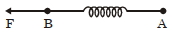
Two masses $A$ and $B ,$ each of mass $M$ are fixed together by a massless spring. $A$ force acts on the mass $B$ as shown in figure. If the mass $A$ starts moving away from mass $B$ with acceleration $'a',$ then the acceleration of mass $B$ wil be :-
The maximum speed of a car on a road-turn of radius $30\, m$, if the coefficient of friction between the tyres and the road is $0.4$, will be .......... $m/sec$
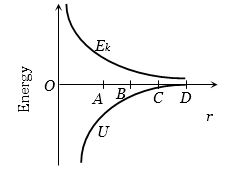
The curves for potential energy $(U)$ and kinetic energy $({E_k})$ of a two particle system are shown in figure. At what points the system will be bound?
A transverse wave is represented by the equation $y = {y_0}\sin \frac{{2\pi }}{\lambda }(vt - x)$ For what value of  $\lambda$, the maximum particle velocity equal to two times the wave velocity
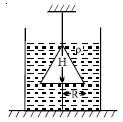
A cone of radius $R$ and height $H$, is hanging inside a liquid of density $\rho$ by means of a string as shown in the figure. The force, due to the liquid acting on the slant surface of the cone is
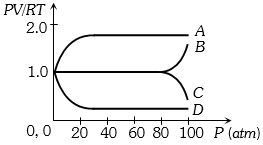
An experiment is carried on a fixed amount of gas at different temperatures and at high pressure such that it deviates from the ideal gas behaviour. The variation of $\frac{{PV}}{{RT}}$ with $P$ is shown in the diagram. The correct variation will correspond to
The physical quantity which has the dimensional formula ${M^1}{T^{ - 3}}$ is
Two identical balls, $A$ and $B$ , of uniform composition and initially at the same temperature, each absorb exactly the same amount of heat. $A$ is hanging down from the ceiling while $B$ rests on the horizontal floor in the same room. Assuming no subsequent heat loss by the balls, which of the following statements is correct about their final temperatures, $T_A$ and $T_B$ , once the balls have reached their final state?
Unit of power is