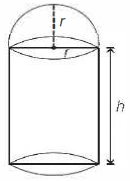
a
(a)
Surface area of solid i.e. $\quad S=2 \pi r^2+2 \pi r h+\pi r^2$
$S=3 \pi r^2+2 \pi r h$
$h=\frac{S-3 \pi r^2}{2 \pi r}$
Volume of solid
$\text { i.e. } \quad V=\pi r^2 h+\frac{2}{3} \pi r^3$
$\Rightarrow \quad V=\pi r^2\left(\frac{S-3 \pi r^2}{2 \pi r}\right)+\frac{2}{3} \pi r^3$
$\Rightarrow \quad \quad V=\frac{1}{2}\left(S r-3 \pi r^3\right)+\frac{2}{3} \pi r^3$
$\Rightarrow \quad \frac{d V}{d r}=\frac{S}{2}-\frac{9 \pi r^2}{2}+2 \pi r^2$
$\text { For maximum or minimum } \frac{d V}{d r}=0$
$\therefore \quad S=5 \pi r^2$
$\Rightarrow \quad h=\frac{S-3 \pi r^2-5 \pi r^2-3 \pi r^2}{2 \pi r}=r$
$\therefore \quad h=r \Rightarrow h: r=1: 1$