MCQ
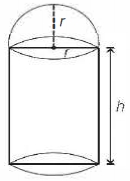
A solid hemisphere is mounted on a solid cylinder, both having equal radii. If the whole solid is to have a fixed surface area and the maximum possible volume, then the ratio of the height of the cylinder to the common radius is
  • $1: 1$
  • B
    $1: 2$
  • C
    $2: 1$
  • D
    $\sqrt{2}: 1$

Answer

Correct option: A.
$1: 1$
a
(a)

Surface area of solid i.e. $\quad S=2 \pi r^2+2 \pi r h+\pi r^2$

$S=3 \pi r^2+2 \pi r h$

$h=\frac{S-3 \pi r^2}{2 \pi r}$

Volume of solid

$\text { i.e. } \quad V=\pi r^2 h+\frac{2}{3} \pi r^3$

$\Rightarrow \quad V=\pi r^2\left(\frac{S-3 \pi r^2}{2 \pi r}\right)+\frac{2}{3} \pi r^3$

$\Rightarrow \quad \quad V=\frac{1}{2}\left(S r-3 \pi r^3\right)+\frac{2}{3} \pi r^3$

$\Rightarrow \quad \frac{d V}{d r}=\frac{S}{2}-\frac{9 \pi r^2}{2}+2 \pi r^2$

$\text { For maximum or minimum } \frac{d V}{d r}=0$

$\therefore \quad S=5 \pi r^2$

$\Rightarrow \quad h=\frac{S-3 \pi r^2-5 \pi r^2-3 \pi r^2}{2 \pi r}=r$

$\therefore \quad h=r \Rightarrow h: r=1: 1$
Need a full question paper?

Generate a complete, print-ready paper with questions like this in minutes — across 16+ boards, with answer keys.

Start Generating Free

Similar questions

$\int_1^2 {\frac{1}{{{x^2}}}{e^{\frac{{ - 1}}{x}}}\,dx = } $
If $\text{A}=\displaystyle \left[ \begin{matrix} 1 &\text{amp; 2} \\ 3&\text{amp; 4} \end{matrix} \right],$ then which of the following is not an element of A ?
The inverse of $y=5^{\log x}$ is
The symmetric equation of lines $3x + 2y + z - 5 = 0$ and $x + y - 2z - 3 = 0$, is
If $D =\left| {\begin{array}{*{20}{c}}{{a^2}\, + \,\,1}&{ab}&{ac}\\{ba}&{{b^2}\, +\,\,1}&{bc}\\{ca}&{cb}&{{c^2}\, + \,\,1}\end{array}} \right|$ then $D =$
The graph of the function $y = f (x)$ passing through the point $(0 , 1)$ and satisfying the differential equation $\frac{{dy}}{{dx}} + y \cos x = \cos x$ is such that
Let $f$ be a function defined on $R$ (the set of all real numbers) such that $f^{\prime}(x)=2010(x-2009)(x-2010)^2$ $(x-2011)^3(x-2012)^4$, for all $x \in R$. If $g$ is a function defined on $R$ with values in the interval $(0, \infty)$ such that $f(x)=\ln (g(x))$, for all $x \in R$, then the number of points in $R$ at which $g$ has a local maximum is
Let $S$ be the set of all integer solutions, $(x, y, z)$, of the system of equations

$x-2 y+5 z=0$

$-2 x+4 y+z=0$

$-7 x+14 y+9 z=0$

such that $15 \leq x^{2}+y^{2}+z^{2} \leq 150 .$ Then, the number of elements in the set $S$ is equal to

Let $S$ be the region bounded by the curves $y=x^{3}$ and $y ^{2}= x$. The curve $y =2| x |$ divides $S$ into two regions of areas $R_{1}$ and $R_{2}$.

If $\max \left\{R_{1}, R_{2}\right\}=R_{2}$, then $\frac{R_{2}}{R_{1}}$ is equal to

If $\frac{\text{d}}{\text{dx}}[\text{x}^\text{n}-\text{a}_1\text{x}^{\text{n}-1}+\text{a}_2\text{x}^{\text{n}-2}+...+(-1)^\text{n}\text{a}_\text{n }]\text{e}^\text{x}=\text{x}^\text{n}\ \text{e}^\text{x},$ then the value of a, 0 < r < is equals to: