MCQ
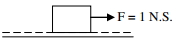
A solid horizontal surface is covered with a thin layer of oil. A rectangular block of mass $m =0.4 kg$ is at rest on this surface. An impulse of $1.0 N s$ is applied to the block at time $t =0$ so that it starts moving along the $x$-axis with a velocity $v ( t )= v _0^{ e ^{-1 / \tau}}$, where $v_0$ is a constant and $\tau=4 s$. The displacement of the block, in metres, at $t=\tau$ is. . . . . . . Take $e ^{-1}=0.37$
  • A
    $6.2$
  • $6.3$
  • C
    $6.4$
  • D
    $6.5$

Answer

Correct option: B.
$6.3$
b
$v = v _0 e ^{-t / \tau}$

$v =\frac{ dS }{ dt }= v _0 e ^{- t / t }$

$\int_0^{ s } dS = v _0 \int_0^\tau e ^{- t / t } dt$

$\Delta S = v _0\left[-\tau e ^{- t / \tau }\right]_0^{ t }$

$\Delta S = v _0 \tau\left[1-\frac{1}{ e }\right]$

$\text { Impulse }=\Delta P = m \Delta v$

$\Delta v =\frac{1}{0.4}=2.5$

$\Delta s =4 \times 2.5[1-0.37]=10 \times 0.63=6.3 m / s$

Need a full question paper?

Generate a complete, print-ready paper with questions like this in minutes — across 16+ boards, with answer keys.

Start Generating Free

Similar questions

Transformer $\rightarrow$ ideal $\rightarrow E _{ p }=1000\, V , I _{ p }=50\, A ,$ $220 V \rightarrow 80$ houses resistances of secondary coil will be (in $\Omega$)
Three bars having length $l, 2l$ and $3l$ and area of cross-section $A, 2 A$ and $3 A$ are joined rigidly end to end. Compound rod is subjected to a stretching force $F$. The increase in length of rod is (Young's modulus of material is $Y$ and bars are massless)
Two point masses having mass $m$ and $2 \,m$ are placed at distance $d$. The point on the line joining point masses, where gravitational field intensity is zero will be at distance ............
A coin is placed on a horizontal platform which undergoes vertical simple harmonic motion of angular frequency $\omega $. The amplitude of oscillation is gradually increased. The coin will leave contact with the platform for the first time
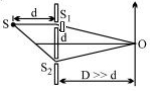
To make the central fringe at the centre $O$, a mica sheet of refractive index $1.5$ is introduced. Choose the correct statements $(s)$.
A fighter plane of length $20\, m$, wing span (distance from tip of one wing to the tip of the other wing) of $15\,m$ and height $5\,m$ is lying towards east over Delhi. Its speed is $240\, ms^{-1}$ . The earth's magnetic field over Delhi is $5 \times 10^{-5}\,T$ with the declination angle $ \sim {0^o}$ and dip of $\theta$ such that $\sin \,\theta  = \frac{2}{3}$. If the voltage developed is $V_B$ between the lower and upper side of the plane and $V_W$ between the tips of the wings then $V_B$ and $V_W$ are close to
A steel rod of diameter $1\,cm$ is clamped firmly at each end when its temperature is $25\,^oC$ so that it cannot contract on cooling. The tension in the rod at $0\,^oC$ is approximately ......... $N$ $(\alpha = 10^{-5}/\,^oC,\,\,Y = 2 \times 10^{11}\,N/m^2)$
If ${R_p} = 7K\Omega ,\,{g_m} = 2.5 \Omega$ millimho, then on increasing plate voltage by $50\,V$, how much the grid voltage is changed so that plate current remains the same.......$V$
A black body at $227^o C$ radiates heat at the rate of $7\; cals/cm^2 s$. At a temperature of $727^o C$, the rate of heat radiated in the same units will be 
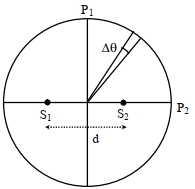
Two coherent monochromatic point sources $S_1$ and $S_2$ of wavelength $\lambda=600 \mathrm{~nm}$ are placed symmetrically on either side of the centre of the circle as shown. The sources are separated by a distance $d=1.8 ~mm$. This arrangement produces interference fringes visible as alternate bright and dark spots on the circumference of the circle. The angular separation between two consecutive bright spots is $\Delta \theta$. Which of the following options is/are correct?

(image)

$[A]$ A dark spot will be formed at the point $\mathrm{P}_2$

$[B]$ At $P_2$ the order of the fringe will be maximum

$[C]$ The total number of fringes produced between $P_1$ and $P_2$ in the first quadrant is close to $3000$

$[D]$ The angular separation between two consecutive bright spots decreases as we move from $P_1$ to $P_2$ along the first quadrant