MCQ
A solid is completely immersed in a liquid. The force exerted by the liquid on the solid will. 
  1. Increase if it is pushed deeper inside the liquid.
  2. Change if its orientation is changed.
  3. Decrease if it is taken partially out bf the liquid.
  4. Be in the vertically upward direction.
  • A
    $1$ and $2$ 
  • B
    $2$ and $3$ 
  • $3$ and $4$
  • D
    $1$ and $4$

Answer

Correct option: C.
$3$ and $4$
The force exerted by the liquid on the solid is the vertically upward force $($buoyant force$)$ that opposes the weight of the immersed solid.​
As more and more volume of the Solid is immersed in the liquid, the buoyant force increases.
Buoyant force depends on the weight of the displaced liquid.
So, maximum upward buoyant force acts on the solid when it is completely immersed in the liquid. It
Decreases if the solid is taken partially out of the liquid.
​​​​​​​Once the object is immersed in the liquid, then pushing it further in the liquid does not increase the
buoyant Force.

Need a full question paper?

Generate a complete, print-ready paper with questions like this in minutes — across 16+ boards, with answer keys.

Start Generating Free

Similar questions

Suppose a planet goes around Sun with a linear speed twice as fast that of earth. What will be it's orbit size as compared to that of earth ? (Radius of earth = R)
In Young's double slit experiment, $62$ fringes are seen in visible region for sodium light of wavelength $5893 Å$. If violet light of wavelength $4358 Å$ is used in place of sodium light, then number of fringes seen will be
An electron with kinetic energy $E$ collides with a hydrogen atom in the ground state. The collision will be elastic
An inductor of $2 \,henry$ and a resistance of $10\,\Omega$ are connected in series with a battery of $5\, volts$. The initial rate of change of current is......$amp/sec$
A point object is placed at the centre of a glass sphere of radius $6 \ cm$ and refractive index $1.5.$ The distance of virtual image from the surface of the sphere is
A condenser of $2\,\mu F$ capacitance is charged steadily from $0$ to $5$ $Coulomb$. Which of the following graphs correctly represents the variation of potential difference across its plates with respect to the charge on the condenser
A point charge $Q$ is moving in a circular orbit of radius $R$ in the $x$-y plane with an angular velocity $\omega$. This can be considered as equivalent to a loop carrying a steady current $\frac{Q_\omega}{2 \pi}$. A uniform magnetic field along the positive z-axis is now switched on, which increases at a constant rate from 0 to $B$ in one second. Assume that the radius of the orbit remains constant. The application of the magnetic field induces an emf in the orbit. The induced emf is defined as the work done by an induced electric field in moving a unit positive charge around a closed loop. It is known that, for an orbiting charge, the magnetic dipole moment is proportional to the angular momentum with a proportionally constant $\gamma$.

$1.$ The magnitude of the induced electric field in the orbit at any instant of time during the time interval of the magnetic field change is :

$(A)$ $\frac{B R}{4}$ $(B)$ $\frac{B R}{2}$ $(C)$ $BR$ $(D)$ $2BR$

$2.$ The change in the magnetic dipole moment associated with the orbit, at the end of the time interval of the magnetic field change, is:

$(A)$ $-\gamma B Q R^2$ $(B)$ $-\gamma \frac{B Q R^2}{2}$ $(C)$ $\gamma \frac{ BQR ^2}{2}$ $(D)$ $\gamma B Q R^2$

Give the answer question $1$ and $2.$
An electron has a mass of $9.1 \times {10^{ - 31}}kg$. It revolves round the nucleus in a circular orbit of radius $0.529 \times {10^{ - 10}}metre$ at a speed of $2.2 \times {10^6}m/s$. The magnitude of its linear momentum in this motion is
A realistic graph depicting the variation of the reciprocal of input resistance in an input characteristics measurement in a common emitter transistor configuration is
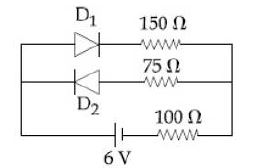
The circuit shown below contains two ideal diodes, each with a forward resistance of $50\,\Omega $. If the battery voltage is $6\,V$, the current through the $100\,\Omega $ resistance (in Amperes) is