MCQ
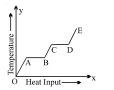
A solid material is supplied with heat at a constant rate. The temperature of material is changing with heat input as shown in the figure. What does slope $DE$ represent.
  • A
    latent heat of liquid
  • B
    latent heat of vapour
  • C
    heat capacity of vapour
  • inverse of heat capacity of vapour

Answer

Correct option: D.
inverse of heat capacity of vapour
d
The part $O A$ is the increase of temperature in solid state.

The part $A B$ is change of state from solid to liquid at constant temperature.

 The part $B C$ is the increase of temperature in liquid state.

The part $C D$ is change of state from liquid to gas at constant temperature.

The part $D E$ is the increase of temperature in gaseous phase, i.e., slope is heat capacity of vapour.

Need a full question paper?

Generate a complete, print-ready paper with questions like this in minutes — across 16+ boards, with answer keys.

Start Generating Free

Similar questions

For a uniformly charged ring of radius $R$, the electric field on its axis has the largest magnitude at a distance $h$ from its centre. Then value of $h$ is
A satellite of mass m is circulating around the earth with constant angular velocity. If radius of the orbit is ${R_0}$ and mass of the earth M, the angular momentum about the centre of the earth is
A stationary particle breaks into two parts of masses $m_A$ and $m_B$ which move with velocities $v_A$ and $V_B$ respectively. The ratio of their kinetic energies $\left(\mathrm{K}_B: \mathrm{K}_{\mathrm{A}}\right)$ is :
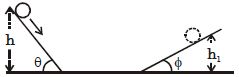
A demonstration apparatus on a table in the lab is shown in diagram. It consists of a metal track (shown as a thick solid line in the figure below) along which a perfectly spherical marble which can roll without slipping. In one run, the marble is released from rest at a height h above the table on the left section, rolls down one side and then up the other side without slipping, briefly stopping when it has reached $h_1$. Assuming the table to be horizontal and neglecting air drag as well as any energy loss due to rolling,
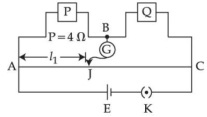
Resistance are connected in a meter bridge circuit as shown in the figure. The balancing length $l_{1}$ is $40\,cm$. Now an unknown resistance $x$ is connected in series with $P$ and new balancing length is found to be $80\,cm$ measured from the same end. Then the value of $x$ will be $.......\Omega$
A standing wave is formed by the superposition of two waves travelling in opposite directions. The transverse displacement is given by $y\left( {x,t} \right) = 0.5\sin\, \left( {\frac{{5\pi }}{4}x} \right)\,\cos\, \left( {200\,\pi t} \right)$. What is the speed of the travelling wave moving in the positive $x$ direction .... $m/s$ ? ($x$ and $t$ are in meter and second, respectively.)
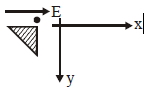
A small point mass carrying some positive charge on it, is released from the edge of a table. There is a uniform electric field in this region in the horizontal direction. Which of the following options then correctly describe the trajectory of the mass ? (Curves are drawn schematically and are not to scale).
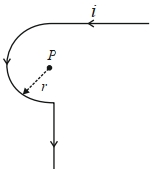
Find the magnetic field at the point $P$ in figure. The curved portion is a semicircle connected to two long straight wires.
Two cars ${X}$ and ${Y}$ are approaching each other with velocities $36\; {km} / {h}$ and $72\; {km} / {h}$ respectively. The frequency of a whistle sound as emitted by a passenger in car ${X}$, heard by the passenger in car ${Y}$ is $1320 \;{Hz}$. If the velocity of sound in air is $340\; {m} / {s}$, the actual frequency of the whistle sound produced is ........ $Hz.$
A metallic conductor of length $1\; m$ rotates in a vertical plane parallel to east-west direction about one of its end with angular velocity $5 \;rad / s$. If the horizontal component of earth's magnetic field is $0.2 \times 10^{-4} \;T$, then emf induced between the two ends of the conductor is .............