MCQ
A solid sphere, a hollow sphere and a disc, all having same mass and radius, are placed at the top of an incline and released. The friction coefficients between the objects and the incline are same and not sufficient to allow pure rolling. Least time will be taken in reaching the bottom by:
  • A
    The solid sphere.
  • B
    The hollow sphere.
  • C
    The disc.
  • All will take same time.

Answer

Correct option: D.
All will take same time.
Let $\theta$ be the inclination angle.

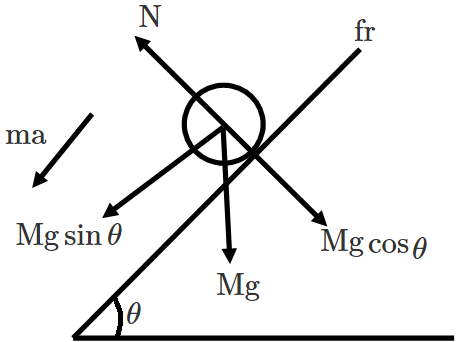
From the free body diagram, we have:
$\text{N}=\text{mg}\cos\theta\ \dots(\text{i})$
$\text{ma}=\text{mg}\sin\theta-\text{f}_{\text{r}}\ \dots(\text{ii})$
Putting $\text{f}_{\text{r}}=\mu\text{N}$ in (ii) we get,
$\text{a}=\text{g}(\sin\theta-\mu\cos\theta)$
The friction coefficients between the objects and the incline are same and not sufficient to allow pure rolling; therefore, all the bodies come down with the same acceleration.

Need a full question paper?

Generate a complete, print-ready paper with questions like this in minutes — across 16+ boards, with answer keys.

Start Generating Free

Similar questions

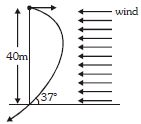
A particle is projected from a tower of height $40\ m$ in horizontal direction. Due to wind a constant acceleration is provided to the particle opposite to its initial velocity. If particle hits the ground (at the bottom of the tower) at an angle $37^o$ with horizontal, then find acceleration provided by wind to the particle 
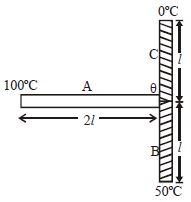
Three rods $A, B$ and $C$ of thermal conductivities $K, 2\,K$ and $4\,K$, cross-sectional  areas $A, 2\,A$ and $2\,A$ and lengths $2l, l$ and $l$ respectively are connected as shown  in the figure. If the ends of the rods are maintained at temperatures $100^o\,C, 50^o\,C$, and $0^o\,C$ respectively, then the temperature $\theta$ of the junction is ......... $^oC$
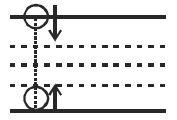
A stone is projected vertically up from the bottom of a water tank. Assuming no water resistance it will go up and come down in same time but if water drag is present then the time it takes to go up, $t_{up}$ and the time it takes to come down, $t_{down}$ are related as
A steam engine intakes $50\, g$ of steam at $100^{\circ} C$ per minute and cools it down to $20^{\circ} C$. If latent heat of vaporization of steam is $540 \,cal g ^{-1}$, then the heat rejected by the steam engine per minute is .........$\times 10^{3}$$cal.$
A body of density $\rho'$  is dropped from rest at a height $h$ into a lake of density $\rho$ , where $\rho > \rho '$ . Neglecting all dissipative forces, calculate the maximum depth to which the body sinks before returning to float on the surface.
A train moving towards a hill at a speed of $72\ km/hr$ sounds a whistle of frequency $500\ Hz$ . A wind is blowing from the hill at a speed of $36\ km/hr$ . If the speed of sound in air is $340\ m/s$ , the frequency heard by a man on the hill (nearly) is ... $Hz$
At extreme position, velocity of the particle executing $\text{SHM}$ that has amplitude $A$ is:
A sphere is released from rest on the incline having friction coefficient $\frac {1}{7}\,\,tan\,\theta $
Two discs of moments of inertia $I_1$ and $I_2$ about their respective axes (normal to  the disc and passing through the centre), and rotating with angular speed $\omega _1$ and $\omega _2$ are  brought into contact face to face with their axes of rotation coincident. What is the  loss in kinetic energy of the system in the process ?
A hollow spherical shell is compressed to half its radius. The gravitational potential at the centre