- The solid sphere.
- The hollow sphere.
- The disc.
- All will take same time.
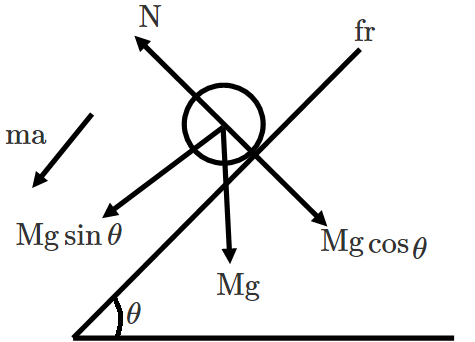
Explanation:
Let $\theta$ be the inclination angle.

From the free body diagram, we have:
$\text{N}=\text{mg}\cos\theta\ \dots(\text{i})$
$\text{ma}=\text{mg}\sin\theta-\text{f}_{\text{r}}\ \dots(\text{ii})$
Putting $\text{f}_{\text{r}}=\mu\text{N}$ in (ii) we get,
$\text{a}=\text{g}(\sin\theta-\mu\cos\theta)$
The friction coefficients between the objects and the incline are same and not sufficient to allow pure rolling; therefore, all the bodies come down with the same acceleration.
Generate a complete, print-ready paper with questions like this in minutes — across 16+ boards, with answer keys.
Flint glass prism is joined by a crown glass prism to produce dispersion without deviation. The refractive indices of these for mean rays are 1.602 and 1.500 respectively. Angle of prism of flint prism is 10°, then the angle of prism for crown prism will be
|
(a) 12°2.4' |
(b) 12°4’ |
(c) 1.24° |
(d) 12° |
Electrons with energy 80 keV are incident on the tungsten target of an X-ray tube. K shell electrons of tungsten have ionization energy 72.5 keV. X-rays emitted by the tube contain only
|
(a) A continuous X-ray spectrum (Bremsstrahlung) with a minimum wavelength of ~ 0.155Å |
|
(b) A continuous X-ray spectrum (Bremsstrahlung] with all wavelengths |
|
(c) The characteristic X-rays spectrum of tungsten |
|
(d) A continuous X-ray spectrum (Bremsstrahlung) with a minimum wavelength of ~ 0.155Å and the characteristic X-ray spectrum of tungsten |
Blue colour of sky is due to:
When an inert gas is filled in the place vacuum in a photo cell, then
|
(a) Photo-electric current is decreased |
|
(b) Photo-electric current is increased |
|
(c) Photo-electric current remains the same |
|
(d) Decrease or increase in photo-electric current does not depend upon the gas filled |
The refractive index of a certain glass is 1.5 for light whose wavelength in vacuum is 6000 Å. The wavelength of this light when it passes through glass is
|
(a) 4000 Å |
(b) 6000 Å |
(c) 9000 Å |
(d) 15000 Å |
The critical angle for a medium is 60°. The refractive index of the medium is
|
(a) |
(b) |
(c) |
(d) |
For the transistor circuit shown below, if b = 100, voltage drop between emitter and base is 0.7 V then value of VCE will be
|
(a) 10 V |
(b) 5 V |
(c) 13 V |
(d) 0 V |