MCQ
A solid sphere and a disc of same mass and radius starts rolling down a rough inclined plane, from the same height the ratio of the time taken in the two cases is
  • A
    $15:14$
  • B
    $\sqrt {15} :\sqrt {14} $
  • C
    $14 : 15$
  • $\sqrt {14} :\sqrt {15} $

Answer

Correct option: D.
$\sqrt {14} :\sqrt {15} $
d
Time of descent  $t = \frac{1}{{\sin \theta }}\sqrt {\frac{{2h}}{g}\left( {1 + \frac{{{k^2}}}{{{R^2}}}} \right)} $

= $\sqrt {\frac{{{{\left( {1 + \frac{{{k^2}}}{{{R^2}}}} \right)}_{{\rm{sphere}}}}}}{{{{\left( {1 + \frac{{{k^2}}}{{{R^2}}}} \right)}_{{\rm{disc}}}}}}} $

$ = \sqrt {\frac{{1 + \frac{2}{5}}}{{1 + \frac{1}{2}}}} $$ = \sqrt {\frac{7}{5} \times \frac{2}{3}}  = \sqrt {\frac{{14}}{{15}}} $

Need a full question paper?

Generate a complete, print-ready paper with questions like this in minutes — across 16+ boards, with answer keys.
Start Generating Free

Similar questions

The velocity and acceleration vectors of a particle undergoing circular motion are $\overrightarrow{ v }=2 \hat{ i } m / s$ and $\overrightarrow{ a }=2 \hat{ i }+4 \hat{ j } m / s ^2$ respectively at an instant of time. The radius of the circle is $........\,m$
Two particles are simultaneously projected in opposite directions horizontally from a given point in space, where gravity $g$ is uniform. If $u_1$ and $u_2$ be their initial speeds, then the time $t$ after which their velocities are mutually perpendicular is given by
A cubical block is floating in a liquid with half of its volume immersed in the liquid. When the whole system accelerates upwards with acceleration of $g/3,$  the fraction of volume immersed in the liquid will be
In the figure shown, the two identical balls of mass $M$ and radius $R$ each, are placed in contact with each other on the frictionless horizontal surface. The third ball of mass $M$ and radius $R/2$, is coming down vertically and has a velocity $= v_0$ when it simultaneously hits the two balls and itself comes to rest. Then, each of the two bigger balls will move after collision with a speed equal to
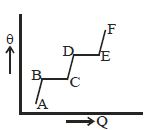
A solid cube having certain fixed melting and boiling points takes heat from some source.The variation  of temperature $\theta$ of the cube with the heat supplied $Q$ is shown in the adjoining graph. The portion $BC$ of the graph represents the conversion of
The following bodies are made to roll up (without slipping) the same inclined plane from a horizontal place: $(i)$ a ring of radius $R,\,(ii)$ a solid cylinder of radius $\frac {R}{2}$  nd $(iii)$ a solid sphere of radius $\frac {R}{4}.$ If, in each case, the speed of the center of mass at bottom of the incline is same, the ratio of the maximum heights they climb is
A piece of ice (heat capacity $=$ $2100$ $J kg^{-1}$ $^o C^{-1}$ and latent heat $=$ $3.36$ $×$ $10^5$ $J kg^{-1}$) of mass $m$ grams is at $-5^o C$ at atmospheric pressure. It is given $420$ $J$ of heat so that the ice starts melting. Finally when the ice-water mixture is in equilibrium, it is found that $1$ $gm$ of ice has melted. Assuming there is no other heat exchange in the process, the value of $m$ is ...... $gm$
A ball is projected vertically down with an initial velocity from a height of $ 20 m$  onto a horizontal floor. During the impact it loses $ 50\% $ of its energy and rebounds to the same height. The initial velocity of its projection is ............ $\mathrm{m} / \mathrm{s}^{-1}$
Sand is being dropped on a conveyer belt at the rate of $M\, kg/s.$ The force necessary to keep the belt moving with a constant velocity of $v\,m/s$ will be
A car moves a distance of $200 \;m$. It covers the first half of the distance at speed $40 \;km / h$ and the second half of distance at speed $v$. The average speed is $48\; km / h$. The value of $v$ is