MCQ
A solid sphere and a hollow cylinder roll up without slipping on same inclined plane with same initial speed $v$. The sphere and the cylinder reaches upto maximum heights $h_1$ and $h_2$, respectively, above the initial level. The ratio $h_1: h_2$ is $\frac{n}{10}$. The value of $\mathrm{n}$ is__________.
  • A
    $6$
  • $7$
  • C
    $8$
  • D
    $9$

Answer

Correct option: B.
$7$
b
$\text { Gain in P.E. }=\text { Loss in K.E. }$

$\mathrm{mgh}=\frac{1}{2} \mathrm{mv}^2\left(1+\frac{\mathrm{K}^2}{\mathrm{R}^2}\right)$

$\mathrm{h} \propto 1+\frac{\mathrm{K}^2}{\mathrm{R}^2}$

$\frac{\mathrm{h}_1}{\mathrm{~h}_2}=\frac{1+\frac{2}{5}}{1+1}=\frac{7}{5 \times 2}=\frac{7}{10}$

$\mathrm{n}=7$

Need a full question paper?

Generate a complete, print-ready paper with questions like this in minutes — across 16+ boards, with answer keys.

Start Generating Free

Similar questions

$Assertion :$ In isothermal process whole of the heat supplied to the body is converted into internal energy.
$Reason :$ According to the first law of thermodynamics :  $\Delta Q = \Delta U + p\Delta V$
A closed organ pipe has a fundamental frequency of $1.5\, kHz$. The number of overtones that can be distinctly heard by a person with this organ pipe will be : (Assume that the highest frequency a person can hear is $20,000\, Hz$)
Two particles $P_1$ and $P_2$ are moving with velocities $v_1$ and $v_2$ respectively. Which of the statement about their relative velocity $v_{12}$ is true?
The variation of the acceleration $a$ of the particle executing $S.H.M.$ with displacement $x$ is as shown in the figure
Force acting on $a$ body of mass $1 kg$ is related to its position $x$ as $F = x^3 - 3x\, N$. It is at rest at $x = 1$. Its velocity at $x = 3$ can be ......... $m/s$
The percentage increase in the speed of transverse waves produced in a stretched string if the tension is increased by $4\, \%$, will be ......... $\%$
1 mole of H2 gas is contained in a box of volume V = 1.00m3 at T = 300K. The gas is heated to a temperature of T = 3000K and the gas gets converted to a gas of hydrogen atoms. The final pressure would be (considering all gases to be ideal).
  1. Same as the pressure initially.
  2. 2 times the pressure initially.
  3. 10 times the pressure initially.
  4. 20 times the pressure initially.
For free expansion of the gas which of the following is true
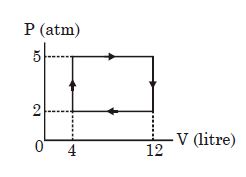
An ideal gas undergoes a cyclic process as shown in diagram. The net work done by the gas in the cycle is
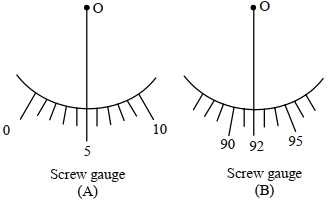
Student $A$ and Student $B$ used two screw gauges of equal pitch and $100$ equal circular divisions to measure the radius of a given wire. The actual value of the radius of the wire is $0.322\, {cm}$. The absolute value of the difference between the final circular scale readings observed by the students $A$ and $B$ is .... .

[Figure shows position of reference $'O'$ when jaws of screw gauge are closed]

Given pitch $=0.1 \,{cm}$.