MCQ
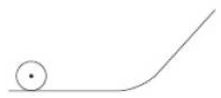
A solid sphere and solid cylinder of identical radii approach an incline with the same linear velocity (see figure). Both roll without slipping all throughout. The two climb maximum heights $h_{sph}$ and $h_{cyl}$ on the incline. The radio $\frac{{{h_{sph}}}}{{{h_{cyl}}}}$ is given by
  • A
    $1$
  • B
    $\frac{4}{5}$
  • C
    $\frac{2}{{\sqrt 5 }}$
  • $\frac{14}{15}$

Answer

Correct option: D.
$\frac{14}{15}$
d
For solid sphere

$\frac{1}{2}m{v^2} + \frac{1}{2} \cdot \frac{1}{2}m{R^2} \cdot \frac{{{V^2}}}{{{R^2}}} = mg{h_{sph}}$

For solid cylinder

$\frac{1}{2}m{V^2} + \frac{1}{2} \cdot \frac{1}{2}m{R^2} \cdot \frac{{{V^2}}}{{{R^2}}} = mg{h_{cyl}}$

$ \Rightarrow \frac{{{h_{sph}}}}{{{h_{cyl}}}} = \frac{{7/5}}{{3/2}} = \frac{{14}}{{15}}$

Need a full question paper?

Generate a complete, print-ready paper with questions like this in minutes — across 16+ boards, with answer keys.

Start Generating Free

Similar questions

A wheel of a bullock cart is rolling on a level road as shown in the figure below. If its linear speed is $v$ in the direction shown, which one of the following options is correct ( $P$ and $Q$ are any highest and lowest points on the wheel, respectively)?
Which of the following quantities do not depend on the choice of zero potential or zero potential energy?
  1. Potential at a point.
  2. Potential difference between two points.
  3. Potential energy of a two-charge system.
  4. Change in potential energy of a two-charge system.
There are two points $P$ and $Q$ on a projectile with velocities $v_P$ and $v_Q$ respectively such that $v_P$ is perpendicular to $v_Q$ and $\alpha$ is the angle that $v_P$ makes with horizontal at point $P$. Find the correct option
A car is moving on a horizontal circular track of radius $0.2 \,km$ with a constant speed. If coefficient of friction between tyres of car and road is $0.45$, then speed of car may be ........ $m / s$ [Take $g=10 \,m / s ^2$ ]
A planet of mass $M$, has two natural satellites with masses $m _1$ and $m _2$. The radii of their circular orbits are $R_1$ and $R_2$ respectively. Ignore the gravitational force between the satellites. Define $v _1, L _1, K _1$ and $T _1$ to be, respectively, the orbital speed, angular momentum, kinetic energy and time period of revolution of satellite $1$ ; and $v_2, L_2, K _2$ and $T _2$ to be the corresponding quantities of satellite $2$ . Given $m _1 / m _2=2$ and $R _1 / R _2=1 / 4$, match the ratios in List-$I$ to the numbers in List-$II$.
List-$I$ List-$II$
$P$ $\frac{ v _1}{ v _2}$ $1$ $\frac{1}{8}$
$Q$ $\frac{ L _1}{ L _2}$ $2$ $1$
$R$ $\frac{ K _1}{ K _2}$ $3$ $2$
$S$ $\frac{ T _1}{ T _2}$ $4$ $8$
Internal energy of a non-ideal gas depends on ..........
An aeroplane is to go along straight line from $A$ to $B$, and back again. The relative speed with respect to wind is $V$. The wind blows perpendicular to line $AB$ with speed $v$. The distance between $A$ and $B$ is $\ell $. The total time for the round trip is
A block is at rest on an inclined plane making an angle $\alpha $ with the horizontal. As the angle $\alpha $ of the incline is increased, the block starts slipping when the angle of inclination becomes $\theta $. The coefficient of static friction between the block and the surface of the inclined plane is 
The velocity- time graph of a body falling from rest under gravity and rebounding from a solid surface is represented by which of the following graphs?
Three solids of masses ${m_1},\,{m_2}$ and ${m_3}$ are connected with weightless string in succession and are placed on a frictionless table. If the mass ${m_3}$ is dragged with a force T, the tension in the string between ${m_2}$ and ${m_3}$ is