MCQ
A solid sphere of radius $R_1$ and volume charge density $P=\frac{P_0}{r}$ is enclosed by a hollow sphere of radius $R_2$ with negative surface charge destiny $\sigma_2$ such that the total charge in the system is zero $P _0$ is positive constant and $r$ is the distance from the centre of sphere the ratio $\frac{ R _2}{ R _1}$ is:
  • A
    $\frac{\sigma}{\text{p}_0}$
  • B
    $\sqrt{\frac{2\sigma}{\text{p}_0}}$
  • $\sqrt{\frac{\text{p}_0}{2\sigma}}$
  • D
    $\frac{\text{p}_0}{\sigma}$

Answer

Correct option: C.
$\sqrt{\frac{\text{p}_0}{2\sigma}}$

Need a full question paper?

Generate a complete, print-ready paper with questions like this in minutes — across 16+ boards, with answer keys.

Start Generating Free

Similar questions

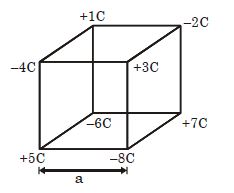
The electric flux passing through the cube for the given arrangement of charges placed at the corners of the cube (as shown in the figure) is 
A prism of refractive index $\sqrt2$ refracting angle $A$ produces minimum deviation $D_m$ of a ray on one face at an angle of incidence $45^o$ . The values of $A$ and $D_m$ are respectively
If in Rutherford’s experiment, the number of particles scattered at 90° angle are 28 per min, then number of scattered particles at an angle 60° and 120° will be
An electron revolves around the nucleus of hydrogen atom in a circle of radius $5 \times 10^{-11} m$. The intensity of electric field at a point in the orbit of the electron is:
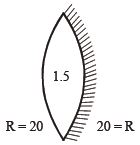
A equiconvex lens of $R = 20 \,cm$ is silvered from one side. Equivalent focal length will  be.....$cm$
When a shunt of $4\,\Omega $ is attached to a galvanometer the deflection reduces to $\frac{1}{5} th$. If an additional shunt of $4\,\Omega $ is attached. What will be the deflection.
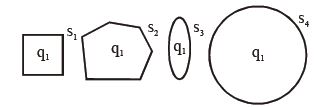
Electric flux through surface $s_1$
The mean square speed of the molecules of a gas at absolute temperature T is proportional to:
$M, M_n$ and $M_p$ denotes the masses of a nucleus of ${ }_Z X^A$, a neutron, and a proton respectively. If the nucleus is separated into its individual protons and neutrons then,
The magnetic field of Earth can be modelled by that of a point dipole placed at the centre of the Earth. The dipole axis makes an angle of $11.3^\circ $ with the axis of Earth. At Mumbai, declination is nearly zero. Then: