Question
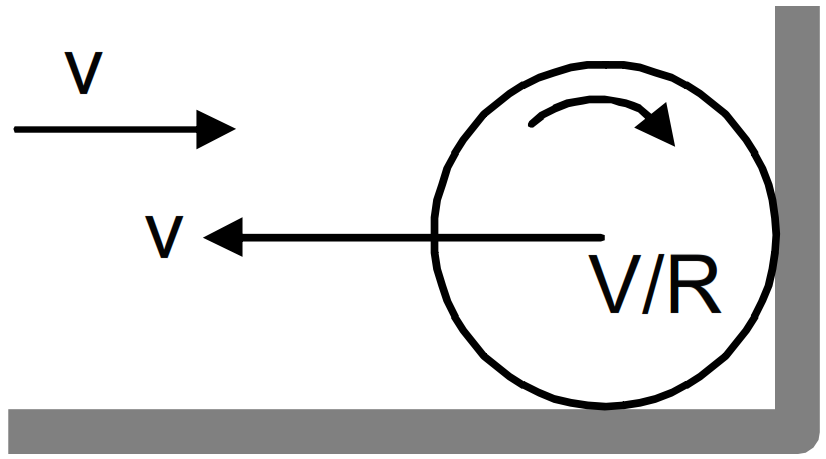
A solid sphere rolling on a rough horizontal surface with a linear speed v collides elastically with a fixed, smooth, vertical wall. Find the speed of the sphere after it has started pure rolling in the backward direction.
Answer


When the solid sphere collides with the wall, it rebounds with velocity ‘v’ towards left but it continues to rotate in the clockwise direction.
So, the angular momentum $=\text{mvR}-\Big(\frac{2}{5}\Big)\text{mR}^2\times\frac{\text{v}}{\text{R}}$
After rebounding, when pure rolling starts let the velocity be v' and the corresponding angular velocity is $\frac{\text{v}'}{\text{R}}$
Therefore angular momentum $=\text{mv}'\text{R}+\Big(\frac{2}{5}\Big)\text{mR}^2\Big(\frac{\text{v}'}{\text{R}}\Big)$
So, $\text{mvR}-\Big(\frac{2}5{}\Big)\text{mR}^2,\ \frac{\text{v}}{\text{R}}=\text{mvR}+\Big(\frac{2}{5}\Big)\text{mR}^2\Big(\frac{\text{v}'}{\text{R}}\Big)$
$\text{mvR}\times\Big(\frac{3}{5}\Big)=\text{mvR}\times\Big(\frac{7}{5}\Big)$
So, the sphere will move with velocity $\frac{\text{3v}}{7}.$

Need a full question paper?

Generate a complete, print-ready paper with questions like this in minutes — across 16+ boards, with answer keys.
Start Generating Free

Similar questions

Why are the magnification properties of microscopes and telescopes defined in terms of the ratio of angles and not in terms of the ratio of sizes of objects and images?
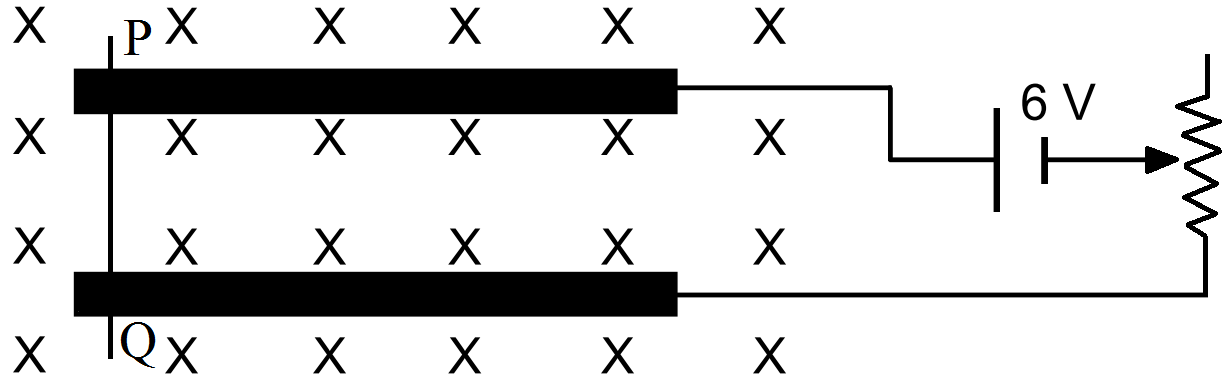
A metal wire PQ of mass 10g lies at rest on two horizontal metal rails separated by 4.90cm A vertically-downward magnetic field of magnitude 0.800T exists in the space. The resistance of the circuit is slowly decreased and it is found that when the resistance goes below 20.0Ω, the wire PQ starts sliding on the rails. Find the coefficient of friction.
Get the electric field due to a uniformly charged thin spherical shell.
When an inductor L and a resistor R in series are connected across a 12 V, 50 Hz supply, a current of 0.5 A flows in the circuit. The current differs in phase from applied voltage by $\pi/3$ radian. Calculate the value of R.
A 3.0 cm wire carrying a current of 10 A is placed inside a solenoid perpendicular to its axis. The magnetic field inside the solenoid is given to be 0.27 T. What is the magnetic force on the wire?
A magnetic field of strength 1.0T is produced by a strong electromagnet in a cylindrical region of radius 4.0cm, as shown in the figure. A wire, carrying a current of 2.0A, is placed perpendicular to and intersecting the axis of the cylindrical region. Find the magnitude of the force acting on the wire.
Find the magnetic field B due to a semicircular wire of radius 10.0cm carrying a current of 5.0A at its centre of curvature.
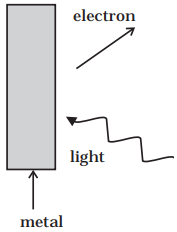
Consider Fig. for photoemission.
How would you reconcile with momentum-conservation? Note light (photons) have momentum in a different direction than the emitted electrons.
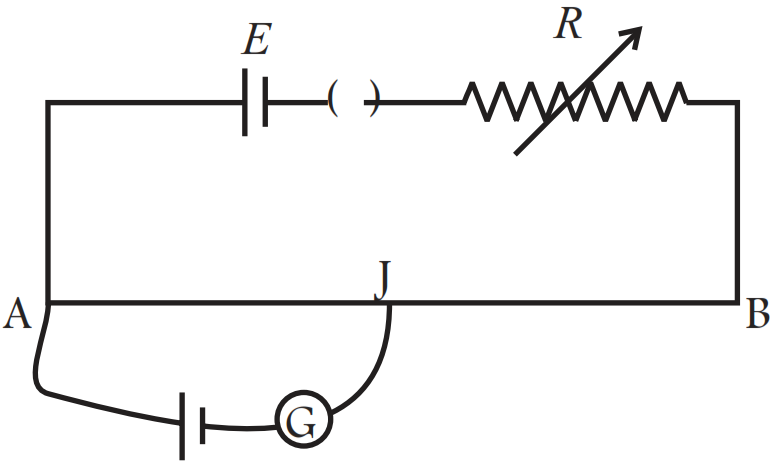
AB is a potentiometer wire (Fig). If the value of R is increased, in which direction will the balance point J shift?
In a parallel plate capacitor with air between the plates, each plate has an area of $6 \times 10^{–3} m^2$ and the distance between the plates is 3 mm. Calculate the capacitance of the capacitor. If this capacitor is connected to a 100 V supply, what is the charge on each plate of the capacitor?