MCQ
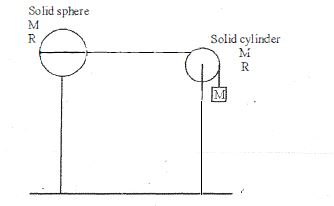
A solid sphere rotates about a vertical axis on frictionless bearing. A massless cord passes around the equator of sphere, then passes through over a solid cylinder and then is connected to block of mass $M$ as  shown in figure. If the system is released from rest then the speed acquired by block after it has fallen through distance $h$ is
  • A
    $\sqrt {\frac{{10gh}}{9}} $
  • $\sqrt {\frac{{20gh}}{19}} $
  • C
    $\sqrt {\frac{{15gh}}{139}} $
  • D
    $\sqrt {\frac{{18gh}}{159}} $

Answer

Correct option: B.
$\sqrt {\frac{{20gh}}{19}} $
b
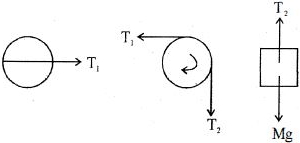
$\mathrm{T}_{1} \mathrm{R}=\frac{2}{5} \mathrm{MR}^{2} \times \frac{\mathrm{a}}{\mathrm{R}}$

$\left(\mathrm{T}_{2}-\mathrm{T}_{1}\right) \mathrm{R}=\frac{1}{2} \mathrm{MR}^{2} \frac{\mathrm{a}}{\mathrm{R}}$

$\mathrm{Mg}-\mathrm{T}_{2}=\mathrm{Ma}$

$\mathrm{Mg}=\mathrm{Ma}\left(\frac{2}{5}+\frac{1}{2}+1\right)$

$g=a \times \frac{19}{10}$

$a=\frac{10 g}{19}$

$v=\sqrt{2 \mathrm{as}}$

$v=\sqrt{2 \times \frac{10 g h}{19}}$

$v=\sqrt{\frac{20 g h}{19}}$

Need a full question paper?

Generate a complete, print-ready paper with questions like this in minutes — across 16+ boards, with answer keys.

Start Generating Free

Similar questions

The temperature of a gas at pressure $P$ and volume $V$ is $27°C.$ Keeping its volume constant if its temperature is raised to $927°C,$ then its pressure will be
The average speed of the bob of a simple pendulum oscillating with a small amplitude $A$ and time period $T$ is
An increases in pressure required to decreases the $200\,\,litres$  volume of a liquid by $0.004\%$  in container is ........... $kPa$. (Bulk modulus of the liquid $= 2100\,\,MPa$ )
Two balls of different masses have the same KE. Then the:
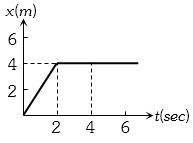
In the figure given below, the position-time graph of a particle of mass $0.1 \,Kg$ is shown. The impulse at $t = 2\sec $ is .......... $kg\,m\,{\sec ^{ - 1}}$
A sine wave is travelling in a medium. The minimum distance between the two particles, always having same speed, is:

  1. $\frac{\lambda}{4}$

  2. $\frac{\lambda}{3}$

  3. $\frac{\lambda}{2}$

  4. $\lambda.$

Consider following statements

$(A)$ Any physical quantity have more than one unit

$(B)$ Any physical quantity have only one dimensional formula

$(C)$ More than one physical quantities may have same dimension

$(D)$ We can add and subtract only those expression having same dimension

Number of correct statement is

Let $\eta_{1}$ is the efficiency of an engine at $T _{1}=447^{\circ}\,C$ and $T _{2}=147^{\circ}\,C$ while $\eta_{2}$ is the efficiency at $T _{1}=947^{\circ}\,C$ and $T _{2}=47^{\circ}\,C$. The ratio $\frac{\eta_{1}}{\eta_{2}}$ will be.
A copper ring has a diameter of exactly $25 \,\,mm$ at its temperature of $0^o C$. An aluminium sphere has a diameter of exactly $25.05\,\, mm$ at its temperature of $100^o C$. The sphere is placed on top of the ring and two are allowed to come to thermal equilibrium, no heat being lost to the surrounding. The sphere just passes through the ring at the equilibrium temperature. The ratio of the mass of the sphere & ring is : (given : $\alpha_{Cu} = 17 × 10^{-6} /^o C, \alpha = 2.3 × 10^{-5} /^o C,$ specific heat of $Cu = 0.0923 Cal/g^o C$ and specific heat of $Al = 0.215 cal/g^o C$)
A hot black body emits the energy at the rate of $16\ J\ m^{-2}\ s^{-1}$ and its most intense radiation corresponds to $20,000\ Å$ . When the temperature of this body is further increased and its most intense radiation corresponds to $10,000\ Å$ , then the energy radiated in $Jm^{-2}\ s^{-1}$ will be