MCQ
A solid sphere spinning about a horizontal axis with an angular velocity $\omega$ is placed on a horizontal surface. Subsequently it rolls without slipping with an angular velocity of
  • A
    $2 \omega / 5$
  • B
    $7 \omega / 5$
  • $2 \omega / 7$
  • D
    $\omega$

Answer

Correct option: C.
$2 \omega / 7$
c
(c)

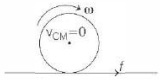
Initially slipping occurs at point of contact and friction acts in forward direction.

Friction produces acceleration of centre of mass.

Acceleration of centre of mass caused by friction is

$a_{ CM }=\frac{F}{m}=\frac{\mu_k m g}{m}=\mu_k g$

Angular deacceleration caused by friction is

$\alpha=\frac{\tau}{I}=\frac{f R}{I}=\frac{-\mu_k m g R}{\frac{2}{\tilde{\partial}} m R^2}=-\frac{5 \mu_k g}{2 R}$

After time $t$, velocity of centre of mass is

$v_{ CM }=u_{ CM }+a_{ CM } t=0+\mu_k g t=\mu_k g t$

and angular velocity is

$\omega=\omega_0+\alpha t=\omega_{0}-\frac{5 \mu_k g}{2 R}, t$

Pure rolling begins

when $\omega-\frac{v_{ CM }-\mu_k g t}{R} \frac{R}{R-\mu_k}$

So, $\quad \frac{\mu_k g t}{R}=\omega_0-\frac{5}{2} \frac{\mu_k g t}{R}$

$\Rightarrow \quad \frac{7}{2} \frac{\mu_k g t}{R}=\omega \Rightarrow t=\frac{2 R \omega_0}{7 \mu_k g}$

So, angular speed when pure rolling occurs is

$\omega_f=\omega+\alpha t=\omega-\frac{5 \mu_k g}{2 R} \cdot \frac{2 R \omega}{7 \mu_k g}$

$=\omega\left(1-\frac{5}{7}\right)=\frac{2}{7} \omega$
Need a full question paper?

Generate a complete, print-ready paper with questions like this in minutes — across 16+ boards, with answer keys.
Start Generating Free

Similar questions

To increase the frequency from $100 Hz$ to $400 Hz$ the tension in the string has to be changed by ..... $times$
The horizontal range and the maximum height of a projectile are equal . The angle of projection of the projectile is
A projectile is thrown with a velocity of $50\,\, ms^{^{-1}}$ at an angle of $53^o$ with the horizontal Determine the instants at which the projectile is at the same height
A $2\,kg$ copper block is heated to $500^o\,C$ and then it is placed on a large block of ice  at $0^o\,C$. If the specific heat capacity of copper is $400\, J/kg/ ^o\,C$ and latent heat of  fusion of water is $3.5 \times 10^5\, J/kg$, the amount of ice, that can melt is :-
The radius of a circle is $2.12$ metre. Its area according to the rule of significant figures is ......... $m ^2$
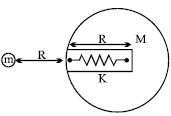
A small ball of mass $‘m’$ is released at a height $‘R’$ above the earth surface, as shown in the figure above. If the maximum depth of the ball to which it goes is $R/2$ inside the earth through a narrow grove before coming to rest momentarily. The grove, contain an ideal spring of spring constant $K$ and natural length $R,$ find the value of $K$ if $R$ is radius of earth and $M$ mass of earth
The percentage errors in quantities $P, Q, R$  and $S$  are $0.5\%,\,1\%,\,3\%$  and  $1 .5\%$ respectively in the  measurement of a physical quantity $A\, = \,\frac{{{P^3}{Q^2}}}{{\sqrt {R}\,S }}$ . the maximum percentage error in the value of $A$  will be ........... $\%$
$10\; amu =$ ……..$kg$
The maximum velocity and the maximum acceleration of a body moving in a simple harmonic oscillator are $2\,m/s$ and $4\,m/{s^2}.$ Then angular velocity will be ..... $rad/sec$
In which of the following processes, heat is neither absorbed nor released by a system ?