MCQ
A solid sphere spinning about a horizontal axis with an angular velocity $\omega$ is placed on a horizontal surface. Subsequently it rolls without slipping with an angular velocity of
  • A
    $2 \omega / 5$
  • B
    $7 \omega / 5$
  • $2 \omega / 7$
  • D
    $\omega$

Answer

Correct option: C.
$2 \omega / 7$
c
(c)

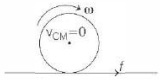
Initially slipping occurs at point of contact and friction acts in forward direction.

Friction produces acceleration of centre of mass.

Acceleration of centre of mass caused by friction is

$a_{ CM }=\frac{F}{m}=\frac{\mu_k m g}{m}=\mu_k g$

Angular deacceleration caused by friction is

$\alpha=\frac{\tau}{I}=\frac{f R}{I}=\frac{-\mu_k m g R}{\frac{2}{\tilde{\partial}} m R^2}=-\frac{5 \mu_k g}{2 R}$

After time $t$, velocity of centre of mass is

$v_{ CM }=u_{ CM }+a_{ CM } t=0+\mu_k g t=\mu_k g t$

and angular velocity is

$\omega=\omega_0+\alpha t=\omega_{0}-\frac{5 \mu_k g}{2 R}, t$

Pure rolling begins

when $\omega-\frac{v_{ CM }-\mu_k g t}{R} \frac{R}{R-\mu_k}$

So, $\quad \frac{\mu_k g t}{R}=\omega_0-\frac{5}{2} \frac{\mu_k g t}{R}$

$\Rightarrow \quad \frac{7}{2} \frac{\mu_k g t}{R}=\omega \Rightarrow t=\frac{2 R \omega_0}{7 \mu_k g}$

So, angular speed when pure rolling occurs is

$\omega_f=\omega+\alpha t=\omega-\frac{5 \mu_k g}{2 R} \cdot \frac{2 R \omega}{7 \mu_k g}$

$=\omega\left(1-\frac{5}{7}\right)=\frac{2}{7} \omega$
Need a full question paper?

Generate a complete, print-ready paper with questions like this in minutes — across 16+ boards, with answer keys.

Start Generating Free

Similar questions

A mouse jumps off from the $15$ th floor of a high-rise building and lands $12 \,m$ from the building. Assume that, each floor is of $3 \,m$ height. The horizontal speed with which the mouse jumps is closest to ...............$km /h$
The temperature of the mixture of one mole of helium and one mole of hydrogen is increased from 0°C to 100°C at constant pressure. The amount of heat delivered will be:
An earth satellite $S$ has an orbit radius which is $4$ times that of a communication satellite $C$. The period of revolution of $S$ is  ........ $days$
An aircraft is moving with a velocity of $300\,m{s^{ - 1}}.$ If all the forces acting on it are balanced, then
Efficiency of all reversible heat engines working between same temperatures:
The amount of energy required to form a soap bubble of radius $2\,cm$ from a soap solution is nearly $..........\,\times 10^{-4}\,J$: (surface tension of soap solution $=0.03\,N\,m ^{-1}$ )
During motion of a planet from perihelion to aphelion the work done by gravitational force of sun on it is ...........
Two walls of thicknesses $d_1$ and $d_2$ and thermal conductivities $k_1$ and $k_2$ are in contact. In the steady state, if the temperatures at the outer surfaces are ${T_1}$ and ${T_2}$, the temperature at the common wall is
A cylindrical tube $(L = 120\,cm.)$ is resonant with a tuning fork of frequency $330\,Hz$. If it is filling by water then to get resonance minimum length of water column is ..... $cm$ $(V_{air} = 330\,m/s)$
Given below are two statements:

Statement $I :$ A second's pendulum has a time period of $1$ second.

Statement $II :$ It takes precisely one second to move between the two extreme positions.

In the light of the above statements, choose the correct answer from the options given below: