MCQ
A solution of acetone in ethanol
- Aobeys Raoult's law
- Bshows a negative deviation from Raoult's law
- ✓shows a positive deviation from Raoult's law
- Dbehaves like a near ideal solution.
Generate a complete, print-ready paper with questions like this in minutes — across 16+ boards, with answer keys.
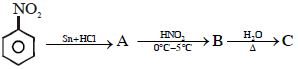
The total number of organic products (ketoxime) formed when the simplest ketone and it's next higher homologue react with $NH_2OH$, is :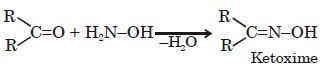
|
${List-I }$ ${(Reactants) }$ |
${List-II }$ ${ Products }$ |
| ($A$)Phenol, $\mathrm{Zn} / \Delta$ |
$(I)$ Salicylaldehyde |
| ($B$)Phenol, $\mathrm{CHCl}_3, \mathrm{NaOH}, \mathrm{HCl}$ |
$(II)$ Salicylic acid |
| ($C$)Phenol, $\mathrm{CO}_2, \mathrm{NaOH}, \mathrm{HCl}$ |
$(III)$ Benzene |
| ($D$)Phenol, Conc. $\mathrm{HNO}_3$ |
$(IV)$ Picric acid |