MCQ
A solution of $y = 2x\left( {\frac{{dy}}{{dx}}} \right) + {x^2}{\left( {\frac{{dy}}{{dx}}} \right)^4}$ is
  • A
    $y = 2{C^{\frac{1}{2}}}{x^{\frac{1}{4}}} + C$
  • B
    $y = 2\sqrt C {x^2} + {C^2}$
  • C
    $y = 2\sqrt C \left( {x + 1} \right)$
  • $y = 2\sqrt {Cx}  + {C^2}$

Answer

Correct option: D.
$y = 2\sqrt {Cx}  + {C^2}$
d
Writing $\mathrm{P}=\frac{\mathrm{dy}}{\mathrm{dx}}$ and differentiating w.r.t. $\mathrm{x} ;$ we have

$\mathrm{P}=2 \mathrm{P}+2 \mathrm{x} \frac{\mathrm{dP}}{\mathrm{dx}}+2 \mathrm{xP}^{4}+4 \mathrm{P}^{3} \mathrm{x}^{2} \frac{\mathrm{dP}}{\mathrm{dx}}$

$\Rightarrow 0=\mathrm{P}\left(1+2 \mathrm{xP}^{3}\right)+2 \mathrm{x} \frac{\mathrm{dP}}{\mathrm{dx}}\left(1+2 \mathrm{P}^{3} \mathrm{x}\right)$

$\Rightarrow \mathrm{P}+2 \mathrm{x} \frac{\mathrm{dP}}{\mathrm{dx}}=0 \Rightarrow 2 \frac{\mathrm{dP}}{\mathrm{p}}=-\frac{\mathrm{dx}}{\mathrm{x}}$

$\Rightarrow 2 \log \mathrm{P}+\log \mathrm{x}=$ constant

$\Rightarrow \mathrm{P}^{2} \mathrm{x}=\mathrm{C} \Rightarrow \mathrm{P}=\sqrt{\mathrm{C} / \mathrm{x}}$

Substituting this value in the given equation, we

get $y=2 \sqrt{C x}+C^{2}$
Need a full question paper?

Generate a complete, print-ready paper with questions like this in minutes — across 16+ boards, with answer keys.

Start Generating Free

Similar questions

${\left[ {\sin \left( {{{\tan }^{ - 1}}\frac{3}{4}} \right)} \right]^2} = $
${{3{x^2} + 5} \over {{{({x^2} + 1)}^2}}} = {a \over {{x^2} + 1}} + {b \over {{{({x^2} + 1)}^2}}}$, then $(a,b) = $
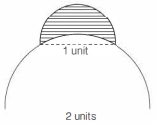
A semi-circle of diameter $1$ unit sits at the top of a semi-circle of diameter $2$ units. semi-circle of diam neter $2$ units.semi-circle of diameter $2$ units.The shaded region inside the smaller semi-circle but outside the larger semi-circle is called a lune. The area of the lune is
If $f(x) = \left\{ {\begin{array}{*{20}{c}}{{e^{\cos x}}\sin x,}&{|x|\, \le 2}\\{2,}&{{\rm{otherwise}}}\end{array}} \right.$, then $\int_{\, - \,2}^{\,3} {f(x)\,dx} $ is equal to
Let $a, a r, a r^2, \ldots . . .$. be an infinite $G.P.$ If $\sum_{n=0}^{\infty} a^n=57$ and $\sum_{n=0}^{\infty} a^3 r^{3 n}=9747$, then $a+18 r$ is equal to :
Let $\mathrm{Q}$ and $\mathrm{R}$ be the feet of perpendiculars from the point $\mathrm{P}(\mathrm{a}, \mathrm{a}, \mathrm{a})$ on the lines $\mathrm{x}=\mathrm{y}, \mathrm{z}=1$ and $\mathrm{x}=-\mathrm{y}$, $\mathrm{z}=-1$ respectively. If $\angle \mathrm{QPR}$ is a right angle, then $12 \mathrm{a}^2$ is equal to
If the primitive of $f (x) = \pi\, \sin\, \pi x + 2x - 4$, has the value $3$ for $x = 1$, then the set of $x$ for which the primitive of $f (x)$ vanishes is :
If $|x+2| \leq 9,$ then...
If $\int\limits_0^{f(x)} {{t^2}\,dt} $ $= x\, \cos\, \pi\, x $, then $f ‘ (9)$
Let $A (0,1), B (1,1)$ and $C (1,0)$ be the mid - points of the sides of a triangle with incentre at the point D. If the focus of the parabola $y^2=4 a x$ passing through $D$ is $(\alpha+\beta \sqrt{2}, 0)$, where $\alpha$ and $\beta$ are rational numbers, then $\frac{\alpha}{\beta^2}$ is equal to