A sonometer wire of resonating length $90 \mathrm{~cm}$ has a fundamental frequency of $400 \mathrm{~Hz}$ when kept under some tension. The resonating length of the wire with fundamental frequency of $600 \mathrm{~Hz}$ under same tension________.$\mathrm{cm}$.
JEE MAIN 2024, Diffcult
Download our app for free and get started
$\mathrm{f}_0=400 \mathrm{~Hz} ; \mathrm{v}=\sqrt{\frac{\mathrm{T}}{\mu}}=\text { constant }$
$\frac{\lambda}{2}=\mathrm{L} ; \mathrm{v}=\mathrm{f}_0 \lambda$
$\frac{\mathrm{v}}{2 \mathrm{f}_0}=\mathrm{L} \Rightarrow \mathrm{v}=2 \mathrm{Lf}_0$
$\mathrm{~L}^{\prime}=\frac{\mathrm{v}}{2 \mathrm{f}^{\prime}}=\frac{2 \mathrm{Lf}_0}{2 \mathrm{f}^{\prime}}$
$=\frac{L f_0}{\mathrm{f}^{\prime}}=\frac{90 \times 400}{600}=60$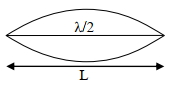

Download our appand get started for free
Experience the future of education. Simply download our apps or reach out to us for more information. Let's shape the future of learning together!No signup needed.*
Similar Questions
- 1The first resonance length of a resonance tube is $40\,\, cm$ and the second resonance length is $122\,\, cm$. The third resonance length of the tube will be... $cm$View Solution
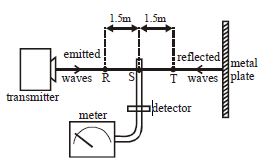
- 2The given diagram shows a detector placed between a transmitter of sound waves and a metal plate. At three adjacent points, $ R, S$ and $T$ , the meter shows zero intensity. Which of the following is the frequency of the emitted wave ... $Hz$ ? (Take the velocity of sound as $ = 300\ m/s$ )View Solution
- 3View SolutionThe nature of sound waves in gases is
- 4View SolutionWith the propagation of a longitudinal wave through a material medium, the quantities transmitted in the propagation direction are
- 5A source of sound gives five beats per second when sounded with another source of frequency $100\,{s^{ - 1}}$. The second harmonic of the source together with a source of frequency $205\,{s^{ - 1}}$ gives five beats per second. What is the frequency of the source .... ${s^{ - 1}}$View Solution
- 6This question has Statement $1$ and Statement $2.$ Of the four choices given after the Statements, choose the one that best describes the two Statements.View Solution
Statement $1:$ In the resonance tube experiment, if the tuning fork is replaced by another identical turning fork but with its arm having been filled, the length of the air column should be increased to obtain resonance again.
Statement $2:$ On filling the arms, the frequency of a tuning fork increases.
- 7In a closed organ pipe of length $105 \,cm$, standing waves are set up corresponding to third overtone. What distance from the closed end, a pressure node is formed .............. $cm$View Solution
- 8For the stationary wave $y = 4\sin \,\left( {\frac{{\pi x}}{{15}}} \right)\cos (96\,\pi t)$, the distance between a node and the next antinode isView Solution
- 9Consider the followingView Solution
$I.$ Waves created on the surfaces of a water pond by a vibrating sources.
$II.$ Wave created by an oscillating electric field in air.
$III.$ Sound waves travelling under water.
Which of these can be polarized
- 10A source producing sound of frequency $170 Hz$ is approaching a stationary observer with a velocity $17 \,ms^{-1}$. The apparent change in the wavelength of sound heard by the observer is (speed of sound in air $= 340 \,ms^{-1}$) ..... $m$View Solution