MCQ
A sonometer wire resonates with a given tuning fork forming standing waves with five antinodes between the two bridges when a mass of $9 kg$ is suspended from the wire. When this mass is replaced by a mass $M$, the wire resonates with the same tuning fork forming three antinodes for the same positions of the bridges. The value of $M$ is ... $kg$
  • $25$
  • B
    $5$
  • C
    $12.5$
  • D
    $\frac{1}{25}$

Answer

Correct option: A.
$25$
a
(a) The frequency of vibration of a string $n = \frac{p}{{2l}}\sqrt {\frac{T}{m}} $ 

Also number of loops = Number of antinodes.

Hence, with $5$ antinodes and hanging mass of $9 kg$. 

We have $p = 5$ and $T = 9g$ ==> ${n_1} = \frac{5}{{2l}}\sqrt {\frac{{9g}}{m}} $ 

With $3$ antinodes and hanging mass $M$

We have $p = 3$ and $T = Mg$

==> ${n_2} = \frac{3}{{2l}}\sqrt {\frac{{Mg}}{m}} $ 

$ \because n_1 = n_2$ 

==> $\frac{5}{{2l}}\sqrt {\frac{{9g}}{m}} = \frac{3}{{2l}}\sqrt {\frac{{Mg}}{m}} $==> $M = 25\, kg.$

Need a full question paper?

Generate a complete, print-ready paper with questions like this in minutes — across 16+ boards, with answer keys.

Start Generating Free

Similar questions

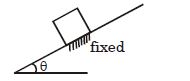
Assume that a block of very low shear modulus is fixed on an inclined plane as shown. Due to elastic forces it will deform. What will be the shape of the block ?
If two satellites of different masses are revolving in the same orbit, they have same:
A piano string $1.5\,m$ long is made of steel of density $7.7 \times 10^3 \,kg/m^3$ and  Young’s modulus $2 \times 10^{11} \,N/m^2$. It is maintained at a tension which produces  an elastic strain of $1\%$ in the string. The fundamental frequency of transverse vibrations of string is ......... $Hz$
In thermal equilibrium, the average velocity of gas molecules is
Two particles are projected from the same point with the same speed $u$ such that they have the same range $R$, but different maximum heights, $h_1$ and $h_2$. Which of the following is correct ?
The cause of Fraunhoffer lines is
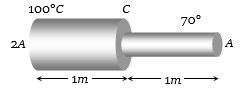
$A$ metal rod of length $2$$m$ has cross sectional areas $2A$ and $A$ as shown in figure. The ends are maintained at temperatures $100°C$ and $70°C$ . The temperature at middle point $C$ is...... $^oC$
If Planck’s constant (h) and speed of light in vacuum (c) are taken as two fundamental quantities, which one of the following can, in addition, be taken to express length, mass and time in terms of the three chosen fundamental quantities?
  1. Mass of electron (me).
  2. Universal gravitational constant (G).
  3. Charge of electron (e).
  4. Mass of proton (mp).
Two projectiles A and B thrown with speeds in the ratio $1:\sqrt{2}$ acquired the same height. If A is thrown at an angle of 45° with the horizontal, then angle of projection of B will be:
A car is moving on a horizontal circular track of radius $0.2 \,km$ with a constant speed. If coefficient of friction between tyres of car and road is $0.45$, then speed of car may be ........ $m / s$ [Take $g=10 \,m / s ^2$ ]