MCQ
A sound absorber attenuates the sound level by $20\ dB$. The intensity decreases by a factor of
  • A
    $10000$
  • B
    $10$
  • $100$
  • D
    $1000$

Answer

Correct option: C.
$100$
c
We have, $\mathrm{L}_{1}=10 \log \left(\frac{\mathrm{I}_{1}}{\mathrm{I}_{0}}\right) ; \mathrm{L}_{2}=10 \log \left(\frac{\mathrm{I}_{2}}{\mathrm{I}_{0}}\right)$

$\therefore \mathrm{L}_{1}-\mathrm{L}_{2}=10 \log \left(\frac{\mathrm{I}_{1}}{\mathrm{I}_{0}}\right)-10 \log \left(\frac{\mathrm{I}_{2}}{\mathrm{I}_{0}}\right)$

or, $\Delta \mathrm{L}=10 \log \left(\frac{\mathrm{I}_{1}}{\mathrm{I}_{0}} \times \frac{\mathrm{I}_{0}}{\mathrm{I}_{2}}\right)$ or, $\Delta \mathrm{L}=10 \log \left(\frac{\mathrm{I}_{1}}{\mathrm{I}_{2}}\right)$

or, $20=10 \log \left(\frac{\mathrm{I}_{1}}{\mathrm{I}_{2}}\right)$ or, $2=\log \left(\frac{\mathrm{I}_{1}}{\mathrm{I}_{2}}\right)$

or, $\frac{\mathrm{I}_{1}}{\mathrm{I}_{2}}=10^{2}$ or, $\mathrm{I}_{2}=\frac{\mathrm{I}_{1}}{100}$

$\Rightarrow$ Intensity decreases by a factor $100 .$

Need a full question paper?

Generate a complete, print-ready paper with questions like this in minutes — across 16+ boards, with answer keys.
Start Generating Free

Similar questions

Amaterial has Poisson's ratio $0.5.$ If a uniform rod of it suffers a longitudinal strain of $2 \times 10^{-3}$, then the percentage change in volume is:
The co-ordinates of a particle moving in $x-y$ plane are given by :  $\mathrm{x}=2+4 \mathrm{t}, \mathrm{y}=3 \mathrm{t}+8 \mathrm{t}^2 .$ The motion of the particle is :
A pressure-pump has a horizontal tube of cross-sectional area $10\,cm ^{2}$ for the outflow of water at a speed of $20\,m / s$. The force exerted on the vertical wall just in front of the tube which stops water horizontally flowing out of the tube, is $...N$ [given : density of water $=1000\,kg / m ^{3}$ ]
The density of a material is $CGS$ system of units is $4\,g/cm^3$. In a system of units in which unit of length is $10\,cm$ and unit of mass is $100\,g$, the value of density of material will be
A particle is moving in a straight line and passes through a point $O$ with a velocity of $6\;m{s^{ - 1}}.$ The particle moves with a constant retardation of $2\;m{s^{ - 2}}\;$ for $4$ s and there after moves with constant velocity. How long after leaving $O$ does the particle return to $O$..........$s$
The fundamental unit which has the same power in the dimension formula of surface tension and viscosity is
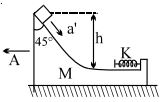
$A$ small block of mass $m$ is placed on $a$ wedge of mass $M$ as shown, which is initially at rest. All the surfaces are frictionless . The spring attached to the other end of wedge has force constant $k$. If $a'$ is the acceleration of $m$ relative to the wedge as it starts coming down and $A$ is the acceleration acquired by the wedge as the block starts coming down, then 
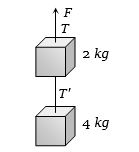
Two blocks are connected by a string as shown in the diagram. The upper block is hung by another string. A force $F$ applied on the upper string produces an acceleration of $2\,m/{s^2}$ in the upward direction in both the blocks. If $T$ and $T'$ be the tensions in the two parts of the string, then $T$ and $T'$
If Poission's ratio $\sigma $ is $ - \frac{1}{2}$ for a material, then the material is
Four uniform wires of the same material are stretched by the same force. The dimensions of wire are as given below. The one which has the minimum elongation has