Question
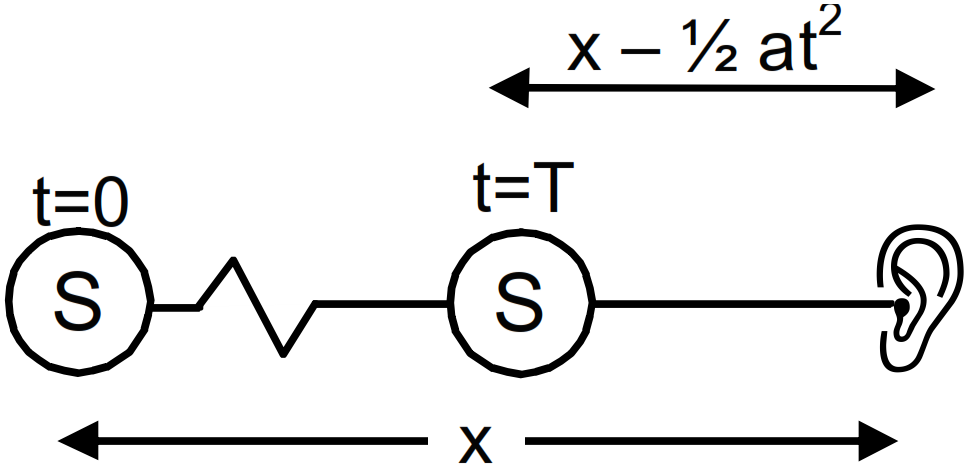
A source emitting a sound of frequency v is placed at a large distance from an observer. The source starts moving towards the observer with a uniform acceleration a. Find the frequency heard by the observer corresponding to the wave emitted just after the source starts. The speed of sound in the medium is u.
Answer

Let the distance between the source and the observer is ‘x’ (initially) So, time taken for the first pulse to reach the observer is $\text{t}_1=\frac{\text{x}}{\text{v}}$ And the second pulse starts after T $\Big($where, $\text{T}=\frac{1}{\text{v}}\Big)$ And it should travel a distance $\Big(\text{x}-\frac{1}{2}\text{a}\text{T}^2\Big).$
So, $\text{t}_2=\text{T}+\frac{\frac{\text{x}-1}{2}\text{a}\text{T}^2}{\text{v}}$$\text{t}_2-\text{t}_1=\text{T}+\frac{\frac{\text{x}-1}{2}\text{aT}^2}{\text{v}}=\frac{\text{x}}{\text{v}}=\text{T}-\frac{1}{2}\frac{\text{aT}^2}{\text{v}}$
Putting = $\text{T}=\frac{1}{\text{v}}.$ we get$\text{t}_2-\text{t}_1=\frac{2\text{uv}-\text{a}}{2\text{vv}^2}$
So, frequency heard $=\frac{2\text{vv}^2}{2\text{uv}-\text{a}}$ $\Big($because, $\text{f}=\frac{1}{\text{t}_2-\text{t}_1}\Big)$

Need a full question paper?

Generate a complete, print-ready paper with questions like this in minutes — across 16+ boards, with answer keys.

Start Generating Free

Similar questions

The focal lengths of a convex lens for red, yellow and violet rays are 100cm, 98cm and 96cm respectively. Find the dispersive power of the material of the lens.
Two particles have equal masses of 5.0g each and opposite charges of $+4.0 \times 10^{-5}\ C$ and $-4.0 \times 10^{-5}C$. They are released from rest with a separation of 1.0m between them. Find the speeds of the particles when the separation is reduced to 50cm.
Identify the logic gate represented by the following circuit by writing its truth table:
An object of size 3.0 cm is placed 14 cm in front of a concave lens of focal length 21 cm. Describe the image produced by the lens. What happens if the object is moved further away from the lens?
A point charge is moving along a straight line with a constant velocity u. Consider a small area A perpendicular to the direction of motion of the charge (El). Calculate the displacement current through the area when its distance from the charge is x. The value of x is not large so that the electric field at any instant is essentially given by Coulomb's law.
The product of the hole concentration and the conduction electron concentration turns out to be independent of the amount of any impurity doped. The concentration of conduction electrons in germanium is $6 \times 10^{19}$ per cubic metre. When some phosphorus impurity is doped into a germanium sample, the concentration of conduction electrons increases to $2 \times 10^{23}$ per cubic metre. Find the concentration of the holes in the doped germanium.
  1. The potential difference applied across a given resistor is altered so that the heat produced per second increases by a factor of 9. By what factor does the applied potential difference change?
  2. In the figure shown, an ammeter A and a resistor of $4\Omega$ are connected to the terminals of the source. The emf of the source is 12 V having an internal resistance of $2\Omega$. Calculate the voltmeter and ammeter readings.
A rod is inserted as the core in the current-carrying solenoid of the previous problem.
  1. What is the magnetic intensity H at the centre?
  2. If the magnetization I of the core is found to be 0.12Nm, find the susceptibility of the material of the rod.
  3. Is the material paramagnetic, diamagnetic or ferromagnetic?
If several forces act on a particle, the total torque on the particle may be obtained by first finding the resultant force and then taking torque of this resultant. Prove this. Is this result valid for the forces acting on different particles of a body in such a way that their lines of action intersect at a common point?
Estimate the change in the density of water in ocean at a depth of 400m below the surface. The density of water at the surface $= 1030kg/m^3$ and the bulk modulus of water $= 2 \times 10^9N/m^2.$