MCQ
A source of sound is moving with constant velocity of $20\, m/s$ emitting a note of frequency $1000 \,Hz.$ The ratio of frequencies observed by a stationary observer while the source is approaching him and after it crosses him will be

(Speed of sound $v = 340\, m/s$)

  • $9:8$
  • B
    $8:9$
  • C
    $1:1$
  • D
    $9:10$

Answer

Correct option: A.
$9:8$
a
(a) When source is approaching the observer, the frequency heard

${n_a} = \left( {\frac{v}{{v - {v_S}}}} \right) \times n = \left( {\frac{{340}}{{340 - 20}}} \right) \times 1000 = 1063Hz$

When source is receding, the frequency heard

${n_r} = \left( {\frac{v}{{v + {v_S}}}} \right) \times n$=$\frac{{340}}{{340 + 20}} \times 1000 = 944$

$ \Rightarrow {n_a}:{n_r} = 9:8$

Short trick : $\frac{{{n_a}}}{{{n_r}}} = \frac{{v + {v_S}}}{{v - {v_S}}} = \frac{{340 + 20}}{{340 - 20}} = \frac{9}{8}.$

Need a full question paper?

Generate a complete, print-ready paper with questions like this in minutes — across 16+ boards, with answer keys.

Start Generating Free

Similar questions

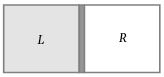
A vessel is partitioned in two equal halves by a fixed diathermic separator. Two different ideal gases are filled in left $(L)$ and right $(R)$ halves. The rms speed of the molecules in $L$ part is equal to the mean speed of molecules in the $R$ part. Then the ratio of the mass of a molecule in $L$ part to that of a molecule in $R$ part is
If a charged particle at rest experiences no electromagnetic force:
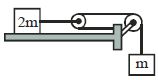
Consider the situation shown in figure. All the surfaces are smooth. The tension in the string connected to $2\,m$ is
Match List $I$ with List $II$ :

List $I$ List $II$
$A$ Isothermal Process $I$ Work done by the gas decreases internal energy
$B$ Adiabatic Process $II$ No change in internal energy
$C$ Isochoric Process $III$ The heat absorbed goes partly to increase internal energy and partly to do work
$D$ Isobaric Process $IV$ No work is done on or by the gas

Choose the correct answer from the options given below :

A man is watching two trains, one leaving and the other coming with equal speed of $4\,m/s$. If they sound their whistles each of frequency $240\, Hz$, the number of beats per sec heard by man will be equal to (velocity of sound in air $= 320\, m/s$)
Entropy of a system decreases .........
Who discovers famous theory of relativity?
How long will a train, running at a speed of $45\ kmph$ cross a standing man, given the length of the train is $450\ m\ ?$
The heat energy required to raise the temperature of $5\,moles$ of an ideal gas to $5\,K$ at constant pressure is $600\,J$ . How much heat (in $J$ ) is required to raise the same mass of the same gas to $5\,K$ at constant volume ? (Take $R = 8.3\,J/mole-^oK$ )
An ideal gas is in thermodynamic equilibrium. The number of degrees of freedom of a molecule of the gas in $n$. The internal energy of one mole of the gas is $U_n$ and the speed of sound in the gas is $v_n$. At a fixed temperature and pressure, which of the following is the correct option?