MCQ
A source of sound of frequency $90$ vibrations/ sec is approaching a stationary observer with a speed equal to $1/10$ the speed of sound. What will be the frequency heard by the observer .... $vibrations/sec$
  • A
    $80$
  • B
    $90 $
  • $100$
  • D
    $120$

Answer

Correct option: C.
$100$
c
(c) $n' = n\,\left( {\frac{v}{{v - {v_s}}}} \right) = 90\,\left( {\frac{v}{{v - \frac{v}{{10}}}}} \right)$ = $100\frac{{Vibration}}{{\sec }}$

Need a full question paper?

Generate a complete, print-ready paper with questions like this in minutes — across 16+ boards, with answer keys.

Start Generating Free

Similar questions

Which of the following statements is true?
What should be the velocity of earth due to rotation about its own axis so that the weight at equator become $3/5$ of initial value. Radius of earth on equator is $ 6400\, km$
Two point masses of mass $m_1 = fM$ and $m_2 = (1 -f)\,M\,(f < 1 )$ are in outer space ( far from gravitational influence of other objects) at a distance $R$ from each other. They move in circular orbits about their centre of mass with angular vaocities $\omega _1$ for $m_1$ and $\omega _2$ for $m_2.$ In that case
An observer standing at station observes frequency $219 Hz$ when a train approaches and $184 Hz$ when train goes away from him. If velocity of sound in air is $340\, m/s$, then velocity of train and actual frequency of whistle will be
In an organ pipe whose one end is at $x = 0$, the pressure is expressed by $p = {p_0}\cos \frac{{3\pi x}}{2} \,\,sin\,\, 300\pi t$  where $x$ is in meter and $t$ in $sec$. The organ pipe can be
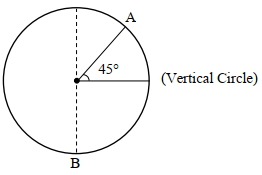
A body of $\mathrm{m} \mathrm{kg}$ slides from rest along the curve of vertical circle from point $A$ to $B$ in friction less path. The velocity of the body at $B$ is:

(given, $\mathrm{R}=14 \mathrm{~m}, \mathrm{~g}=10 \mathrm{~m} / \mathrm{s}^2$ and $\sqrt{2}=1.4$ )
A cannon ball is fired with a velocity $200\, m/sec$ at an angle of $60° $ with the horizontal. At the highest point of its flight it explodes into $3$ equal fragments, one going vertically upwards with a velocity $100 \,m/sec$, the second one falling vertically downwards with a velocity $100\, m/sec$. The third fragment will be moving with a velocity
Match List $I$ with List $II$ :

List $I$ (Physical Quantity) List $II$ (Dimensional Formula)
$(A)$ Pressure gradient $(I)$ $\left[ M ^0 L ^2 T ^{-2}\right]$
$(B)$ Energy density $(II)$ $\left[ M ^1 L ^{-1} T ^{-2}\right]$
$(C)$ Electric Field $(III)$ $\left[ M ^1 L ^{-2} T ^{-2}\right]$
$(D)$ Latent heat $(IV)$ $\left[ M ^1 L ^1 T ^{-3} A ^{-1}\right]$

Choose the correct answer from the options given below:
Find moment of inertia of a uniform annular disc of mass $100 \,g$, having inner radius $10\, cm$ and outer radius $20\, cm$, about an axis passing through its centre and perpendicular to its plane.
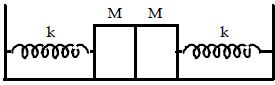
An assembly of identical spring-mass systems is placed on a smooth horizontal surface as shown. Initially the springs are relaxed. The left mass is displaced to the left while the right mass is displaced to the right and released. The resulting collision is elastic. The time period of the oscillations of the system is :-