MCQ
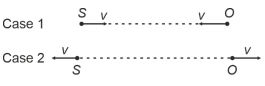
A source $(S)$ of sound has frequency $240 \ Hz$. When the observer $(O)$ and the source move towards each other at a speed $v$ with respect to the ground (as shown in Case $1$ in the figure), the observer measures the frequency of the sound to be $288 \ Hz$. However, when the observer and the source move away from each other at the same speed $v$ with respect to the ground (as shown in Case $2$ in the figure), the observer measures the frequency of sound to be $n Hz$. The value of $n$ is. . . . . .
  • $200$
  • B
    $400$
  • C
    $500$
  • D
    $600$

Answer

Correct option: A.
$200$
a
Frequency received by observer $f_0=\left(\frac{C \pm V_0}{C \pm V_s}\right) f_s, C$ is speed of sound

Case-$1$:

$f _1=\left(\frac{ C + V }{ C - V }\right) f _{ s }$

$288=\left(\frac{ C + V }{ C - V }\right) 240$

Case-$2$:

$f _2=\left(\frac{ C - V }{ C + V }\right) f _{ s }$

$n =\left(\frac{ C - V }{ C + V }\right) 2400$

multiply the two equations, we get.

$(288)( n )=(240)(240)$

$N =200$

Need a full question paper?

Generate a complete, print-ready paper with questions like this in minutes — across 16+ boards, with answer keys.

Start Generating Free

Similar questions

The $S.I.$ unit of gravitational potential is
A physical quantity $z$ depends on four observables $a,$ $b,$ $c$ and $d ,$ as $z =\frac{ a ^{2} b ^{\frac{2}{3}}}{\sqrt{ c } d ^{3}} .$ The percentage of error in the measurement of $a, b, c$ and $d$ are $2 \%, 1.5 \%, 4 \%$ and $2.5 \%$ respectively. The percentage of error in $z$ is$......\%$
The top of a water tank is open to air and its water level is maintained. It is giving out $0.74\,m^3$ water per minute through a circular opening of $2\,cm$ radius in its wall. The depth of the centre of the opening from the level of water in the tank is close to........ $m$
A projectile crosses two walls of equal height $H$ symmetrically as shown  The time of flight $T$ is given by  ........ $\sec$
The acceleration $a$ of a particle undergoing $S.H.M.$ is shown in the figure. Which of the labelled points corresponds to the particle being at -$x_{max}$
One end of a massless spring of spring constant $k$ and natural length $l_{0}$ is fixed while the other end is connected to a small object of mass $m$ lying on a frictionless table. The spring remains horizontal on the table. If the object is made to rotate at an angular velocity $\omega$ about an axis passing through fixed end, then the elongation of the spring will be
The given diagram shows four processes i.e., isochoric, isobaric, isothermal and adiabatic. The correct assignment of the processes, in the same order is given by
A body is moving from rest under constant acceleration and let ${S_1}$ be the displacement in the first $(p - 1)$ sec and ${S_2}$ be the displacement in the first $p\,\sec .$ The displacement in ${({p^2} - p + 1)^{th}}$ sec. will be
If potential at the surface of earth is assigned zero value, then potential at centre of earth will be (Mass $=M$, Radius $=R$ )
The length of second's hand in watch is $1 \,cm.$ The change in velocity of its tip in $15$ seconds is