Question
A spectroscopic instrument can resolve two nearby wavelengths $\lambda$ and $\lambda+\Delta\lambda$ if $\frac{\lambda}{\Delta\lambda}$ is smaller than 8000. This is used to study the spectral lines of the Balmer series of hydrogen. Approximately how many lines will be resolved by the instrument?

Answer

The range of Balmer series is 656.3nm to 365nm. It can resolve $\lambda$ and $\lambda+\Delta\lambda$ if $\frac{\lambda}{\Delta\lambda}=8000$
$\therefore$ No. of wavelength in the range $=\frac{656.3-365}{8000}=36$
Total no. of lines 36 + 2 = 38 [extra two is for first and last wavelength]

Need a full question paper?

Generate a complete, print-ready paper with questions like this in minutes — across 16+ boards, with answer keys.

Start Generating Free

Similar questions

Define equipotential surface. Write its characteristics.
A mosquito net over a 7ft × 4ft bed is 3ft high. The net has a hole at one corner of the bed through which a mosquito enters the net. It flies and sits at the diagonally opposite upper corner of the net.
  1. Find the magnitude of the displacement of the mosquito.
  2. Taking the hole as the origin, the length of the bed as the X-axis, its width as the Y-axis, and vertically up as the Z-axis, write the components of the displacement vector.
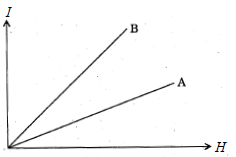
The following figure shows the variation of intensity of magnetisation versus the applied magnetic field intensity, H, for two magnetic materials A and B:
  1. Identify the materials A and B.
  2. Why does the material B, have a larger susceptibility than A, for a given field at constant temperature?
Define equipotential surface.
What is energy levels? How these are represented?
Suppose, in certain conditions only those transitions are allowed to hydrogen atoms in which the principal quantum number n changes by 2. (a) Find the smallest wavelength emitted by hydrogen. (b) List the wavelength emitted by hydrogen in the visible range (380nm to 780nm).
A hydrogen atom contains one proton and one electron. It may be assumed that the electron revolves in a circle of radius 0.53 angstrom (1 angstrom $= 10^{-10}m$ and is abbreviated as A) with the proton at the centre. The hydrogen atom is said to be in the ground state in this case. Find the magnitude of the electric force between the proton and the electron of a hydrogen atom in its ground state.
A pendulum having time period equal to two seconds is called a seconds pendulum. Those used in pendulum clocks are of this type. Find, the length of a seconds pendulum at a place where $\text{g}=\pi^2\text{m/s}^2.$
A deuteron and an alpha particle having same momentum are in turn allowed to pass through a magnetic field $\vec{B}$, acting normal to the direction of motion of the particles. Calculate the ratio of the radii of the circular paths described by them.
An iron needle is attracted to the ends of a bar magnet but not to the middle region of the magnet. Is the material making up the ends of a bar magnet different from that of the middle region?