MCQ
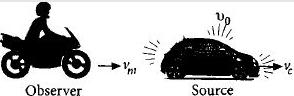
A speeding motorcyclist sees traffic jam ahead him. He slows down to $36\,\, km\,\,hour^{-1}$ He finds that traffic has eased and a car moving ahead of him at $18 \,\, km\,\,hour^{-1}$ is honking at a frequency of $1392\,\, Hz.$ If the speed of sound is $343\, m s^{-1}$, the frequency of the honk as heard by him will be .... $Hz$
  • A
    $1332$
  • B
    $1372$
  • $1412$
  • D
    $1454$

Answer

Correct option: C.
$1412$
c
Here, speed of motorcyclist, $v_{m}=36 \mathrm{km}$ hour $^{-1}$

$=36 \times \frac{5}{18}=10 \mathrm{ms}^{-1}$

Speed of car,

$v_{c}=18 \mathrm{km} \text { hour }^{-1}=18 \times \frac{5}{18} \mathrm{ms}^{-1}=5 \mathrm{ms}^{-1}$

Frequency of source, $v_{0}=1392 \mathrm{Hz}$

Speed of sound, $v=343 \mathrm{ms}^{-1}$

The frequency of the honk heard by the motorcyclist is

$v^{\prime} =v_{0}\left(\frac{v+v_{m}}{v+v_{c}}\right)=1392\left(\frac{343+10}{343+5}\right)$

$=\frac{1392 \times 353}{348}=1412 \mathrm{Hz}$

Need a full question paper?

Generate a complete, print-ready paper with questions like this in minutes — across 16+ boards, with answer keys.

Start Generating Free

Similar questions

A block of mass $m = 0.1\,kg$ is connected to a spring of unknown spring constant $k.$ It is compressed to a distance $x$ from its equilibrium. position and released from rest . After approaching half the distance $(\frac {x}{2})$ from equilibrium position, it hits another block and comes to rest momentarily, while the other block moves with a velocity $3\,ms^{-1}.$ The total initial energy of the spring is ................ $\mathrm{J}$
The average kinetic energy of a monatomic molecule is $0.414 \mathrm{eV}$ at temperature :

(Use $\mathrm{K}_{\mathrm{B}}=1.38 \times 10^{-23} \mathrm{~J} / \mathrm{mol}-\mathrm{K}$ )

Newton's first law of motion describes the following
If a particle is moving along straight line with increasing speed, then
If a lighter body (mass ${M_1}$ and velocity ${V_1}$) and a heavier body (mass ${M_2}$ and velocity ${V_2}$) have the same kinetic energy, then
A uniform metal chain of mass $m$ and length ' $L$ ' passes over a massless and frictionless pulley. It is released from rest with a part of its length ' $l$ ' is hanging on one side and rest of its length ' $L -l$ ' is hanging on the other side of the pulley. At a certain point of time, when $l=\frac{L}{x}$, the acceleration of the chain is $\frac{g}{2}$. The value of $x$ is ........
Angle between the vectors $(\hat i + \hat j)$ and $(\hat j - \hat k)$ is ........ $^o$
Conservation of momentum in a collision between particles can be understood from:
A body of mass $10 kg$ is projected at an angle of $45^{\circ}$ with the horizontal. The trajectory of the body is observed to pass through a point $(20,10)$. If $T$ is the time of flight, then its momentum vector, at time $t =\frac{ T }{\sqrt{2}}$, is.

$\left[\right.$ Take $\left.g=10 m / s ^{2}\right]$

A uniform cubical block is subjected to volumetric compression, which decreases its each side by $2 \%$. The Bulk strain produced in it is ............