MCQ
A sphere, a cube and a thin circular plate, all made of the same material and having the same mass are initially heated to a temperature of $1000°C$ . Which one of these will cool first
  • Plate
  • B
    Sphere
  • C
    Cube
  • D
    None of these

Answer

Correct option: A.
Plate
a
(a) Rate of cooling $\frac{{\Delta \theta }}{t} = \frac{{A\varepsilon \sigma ({T^4} - T_0^4)}}{{mc}}$

==> $\frac{{\Delta \theta }}{t} \propto A$. Since area of plate is largest so it will cool fastest.

Need a full question paper?

Generate a complete, print-ready paper with questions like this in minutes — across 16+ boards, with answer keys.

Start Generating Free

Similar questions

A particle executes harmonic motion with an angular velocity and maximum acceleration of $3.5\, rad/sec$ and $ 7.5\, m/s^2$ respectively. The amplitude of oscillation is .... $m$
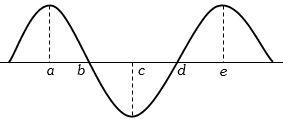
The rope shown at an instant is carrying a wave travelling towards right, created by a source vibrating at a frequency $n$. Consider the following statements

$I.$ The speed of the wave is $4n \times ab$

$II.$ The medium at $a$ will be in the same phase as $d$ after $\frac{4}{{3n}}s$

$III.$ The phase difference between $b$ and $e$ is $\frac{{3\pi }}{2}$

Which of these statements are correct
With rise in temperature, the Young's modulus of elasticity
If the maximum velocity and maximum acceleration of a particle executing $SHM$ are equal in magnitude, the time period will be .... $\sec$
Kepler's third law states that square of period of revolution $(T)$ of a planet around the sun, is proportional to third power of average distance $r$ between sun and planet i.e.

$\therefore \;{T^2} = k{r^3}$

here $K$ is constant.

If the masses of sun and planet are $M$ and $m$ respectively then as per Newton's law of gravitation force of attraction between them is $F = \frac{{GMm}}{{{r^2}}}$ , here $G$ gravitational constant . The relation between $G$ and $K$ is described as
All the graphs below are intended to represent the same motion. One of them does it incorrectly. Pick it up.
A bullet looses ${\left( {\frac{1}{n}} \right)^{th}}$ of its velocity passing through one plank. The number of such planks that are required to stop the bullet can be
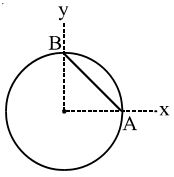
An object comprises of $a$ uniform ring of radius $R$ and its uniform chord $AB$ (not necessarily made of the same material) as shown. Which of the following can not be the centre of mass of the object
In kinetic theory’ of gases, it is assumed that:
On a rough horizontal surface, a body of mass $2 \,kg$ is given a velocity of $10 \,m/s$. If the coefficient of friction is $0.2$ and $g = 10\, m/{s^2}$, the body will stop after covering a distance of ........ $m$