MCQ
A sphere and a cube of same material and same volume are heated upto same temperature and allowed to cool in the same surroundings. The ratio of the amounts of radiations emitted will be
  • A
    $1:1$
  • B
    $\frac{{4\pi }}{3}\,\,:\,\,1$
  • ${\left( {\frac{\pi }{6}} \right)^{1/3}}:\,\,1$
  • D
    $\frac{1}{2}\,{\left( {\frac{{4\pi }}{3}} \right)^{2/3}}:\,\,1$

Answer

Correct option: C.
${\left( {\frac{\pi }{6}} \right)^{1/3}}:\,\,1$
c
(c) $Q$ = $\sigma$ $A$ t ($T_4$ -$T_0^4$)

If $T, T_0, \sigma $ and t are same for both bodies then $\frac{{{Q_{sphere}}}}{{{Q_{cube}}}} = \frac{{{A_{sphere}}}}{{{A_{cube}}}} = \frac{{4\pi {r^2}}}{{6{a^2}}}$ …..$(i)$

But according to problem, volume of sphere = Volume of cube

==> $\frac{4}{3}\pi {r^3} = {a^3}$

==> $a = {\left( {\frac{4}{3}\pi } \right)^{1/3}}r$

Substituting the value of a in equation $(i)$ we get

$\frac{{{Q_{sphere}}}}{{{Q_{cube}}}} = \frac{{4\pi {r^2}}}{{6{a^2}}} = \frac{{4\pi {r^2}}}{{6{{\left\{ {{{\left( {\frac{4}{3}\pi } \right)}^{1/3}}r} \right\}}^2}}}$

$ = \frac{{4\pi {r^2}}}{{6\,{{\left( {\frac{4}{3}\pi } \right)}^{2/3}}{r^2}}} = {\left( {\frac{\pi }{6}} \right)^{1/3}}:1$
Need a full question paper?

Generate a complete, print-ready paper with questions like this in minutes — across 16+ boards, with answer keys.

Start Generating Free

Similar questions

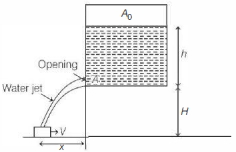
Consider the configuration of a stationary water tank of cross-section area $A_{0}$ and a small bucket as shown in figure below; the speed $v$ is .......... $m/s$ of the bucket, so that the water leaking out of a hole of cross-section area $A$ (as shown) from the water tank does not fall outside the bucket? (Take, $h=5 \,m , H=5 \,m , g=10 \,m / s ^{2}, A=5 \,cm ^{2}$ and $\left.A_{0}=500 \,cm ^{2}\right)$.
If two balls each of mass $0.06 \,kg$ moving in opposite directions with speed $4 \,m/s$ collide and rebound with the same speed, then the impulse imparted to each ball due to other is ...........  $kg-m/s$
The moments of inertia of a non-uniform circular disc (of mass $M$ and radius $R$ ) about four mutually perpendicular tangents $A B, B C, C D, D A$ are $I_1, I_2, I_3$ and $I_4$, respectively (the square $A B C D$ circumscribes the circle). The distance of the centre of mass of the disc from its geometrical centre is given by
A $U-$ tube is such that the diameter of one limb is $0.4\,mm$ and that of other is $d\, mm$ . If the surface tension of water contained in the tube is $0.07\,N/m$ and the difference in the levels of liquid in the limbs is $3.6\,cm,$ then the value of $d$ is
A rubber cord catapult has cross-sectional area $25\,m{m^2}$ and initial length of rubber cord is $10\,cm.$ It is stretched to $5\,cm.$ and then released to project a missile of mass $5gm.$ Taking ${Y_{rubber}} = 5 \times {10^8}N/{m^2}$ velocity of projected missile is ......... $ms^{-1}$
Two rods having thermal conductivity in the ratio of $5 : 3$ having equal lengths and equal cross-sectional area are joined by face to face. If the temperature of the free end of the first rod is $100°C$ and free end of the second rod is $20°C$ . Then temperature of the junction is...... $^oC$
Two particles are simultaneously projected in opposite directions horizontally from a given point in space, where gravity $g$ is uniform. If $u_1$ and $u_2$ be their initial speeds, then the time $t$ after which their velocities are mutually perpendicular is given by
Boyle's law holds for an ideal gas during
An Indian rubber cord $L$ metre long and area of cross-section $A$ $metr{e^2}$ is suspended vertically. Density of rubber is $D$ $kg/metr{e^3}$ and Young's modulus of rubber is $E$ $newton/metr{e^2}$. If the wire extends by $l$ metre under its own weight, then extension $l$ is
A simple pendulum made of a bob of mass $m$ and a metallic wire of negligible mass has time period $2s$ at  $T = 0\,^oC$ . If the temeprature of the wire is increased and the corresponding change in its time peirod is plotted against its temperature, the resulting graph is a line of slope $S$. If the coefficient of linear expansion of metal is $\alpha $ then the value of  $S$ is