Question
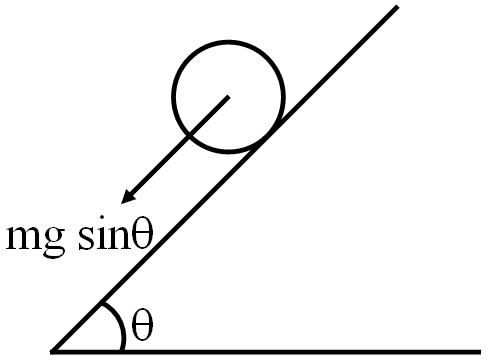
A sphere cannot roll on:
  1. A smooth horizontal surface.
  2. A smooth inclined surface.
  3. A rough horizontal surface.
  4. A rough inclined surface.

Answer

  1. A smooth horizontal surface.
  2. A smooth inclined surface.

Explanation:

A sphere cannot roll on a smooth inclined surface and on a smooth horizontal surface because there is no backward force (force of friction) to prevent its slipping.

Need a full question paper?

Generate a complete, print-ready paper with questions like this in minutes — across 16+ boards, with answer keys.

Start Generating Free

Similar questions

One requires 11eV of energy to dissociate a carbon monoxide molecule into carbon and oxygen atoms. The minimum frequency of the appropriate electromagnetic radiation to achieve the dissociation lies in:
The magnetic field of Earth can be modelled by that of a point dipole placed at the centre of the Earth. The dipole axis makes an angle of 11.3º with the axis of Earth. At Mumbai, declination is nearly zero. Then:

The apparent wavelength of the light from a star moving away from the earth is 0.01% more than its real wavelength. Then the velocity of star is

(a) 60 km/sec

(b) 15 km/sec

(c) 150 km/sec

(d) 30 km/sec

An electric bulb is rated 220 volt and 100 watt. Power consumed by it when operated on 110 volt is

(a) 50 watt

(b) 75 watt

(c) 90 watt

(d) 25 watt

A varying current in a coil changes from 10 amp to zero in 0.5 sec. If average EMF is induced in the coil is 220 volts, the self inductance of coil is

(a) 5 H

(b) 10 H

(c) 11 H

(d) 12 H

A circular coil ‘A’ has a radius R and the current flowing through it is I. Another circular coil ‘B’ has a radius 2R and if 2I is the current flowing through it, then the magnetic fields at the centre of the circular coil are in the ratio of (i.e.   to )

(a) 4 : 1   

(b) 2 : 1

(c) 3 : 1    

(d) 1 : 1

On increasing the temperature of a semi-conductor material:
The rubber used in the wheels of aero-plane is _________?
The angular momentum of the α−particles which are scattered through large angles by the heavier nuclei, is conserved because:

In the above question, potential difference across the 40Ω resistance will be

(a) Zero

(b) 80 V

(c) 40 V

(d) 120 V