MCQ
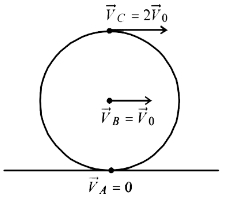
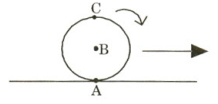
A sphere is rolling without slipping on a fixed horizontal plane surface. In the figure, $\mathrm{A}$ is the point of contact, $\mathrm{B}$ is the centre of the sphere and $\mathrm{C}$ is its topmost point. Then,

$(A)$ $\vec{V}_C-\vec{V}_A=2\left(\vec{V}_B-\vec{V}_C\right)$

$(B)$ $\vec{V}_C-\vec{V}_B=\vec{V}_B-\vec{V}_A$

$(C)$ $\left|\vec{V}_C-\vec{V}_A\right|=2\left|\vec{V}_B-\vec{V}_C\right|$

$(D)$ $\left|\vec{V}_C-\vec{V}_A\right|=4\left|\vec{V}_B\right|$
  • $(B,C)$
  • B
    $(B,D)$
  • C
    $(A,C)$
  • D
    $(A,D)$

Answer

Correct option: A.
$(B,C)$
a
If $\vec{V}_0$ is the velocity of centre of the sphere, then

$\vec{V}_C=2 \vec{V}_0, \vec{\rightarrow} B=\vec{V}_0 \text { and } \rightarrow A=0$

$\therefore \vec{V}_C-\vec{V}_B=2 \vec{V}_0-\vec{V}_0=\vec{V}_0$

$\vec{V}_B-\vec{V}_A=\vec{V}_0-\overrightarrow{0}=\vec{V}_0$

$\therefore \vec{V}_C-\vec{V}_B=\vec{V}_B-\vec{V}_A$

$(b)$ is the correct opton.

Now, $\left|\vec{V}_C-\vec{V}_A\right|=\left|2 \vec{V}_0-0\right|=\left|2 \vec{V}_0\right|=2\left|\vec{V}_0\right|$

and $\left|\vec{V}_C-\vec{V}_A\right|=2\left|\vec{V}_B-\vec{V}_C\right|$

$(c)$ is the correct option.

Need a full question paper?

Generate a complete, print-ready paper with questions like this in minutes — across 16+ boards, with answer keys.

Start Generating Free

Similar questions

A thin walled cylindrical metal vessel of linear coefficient of expansion $10^{-3} $ $^o C^{-1}$ contains benzenr of volume expansion coefficient $10^{-3}$ $^o C^{-1}$. If the vessel and its contents are now heated by $10^o C,$ the pressure due to the liquid at the bottom.
If a rubber ball falls from a height $h$ and rebounds upto the height of $h / 2$. The percentage loss of total energy of the initial system as well as velocity ball before it strikes the ground, respectively, are :
A projectile is given an initial velocity of $(\hat i + 2\hat j)\ ms^{-1}$, where $\hat i$ is along the ground and $\hat j$ is along the vertical. If $g = 10\ m/s^2$ , the equation of its trajectory is
Moon has no atmosphere because:
The two vectors have magnitudes $3$ and $5$. If angle between them is $60^o$, then the dot product of two vectors will be
An ideal diatomic gas is heated at constant pressure. The ratio of the work done to the heat supplied is
A bar of mas $M=1.00 \mathrm{~kg}$ and length $L=0.20 \mathrm{~m}$ is lying on a horizontal frictionless surface. One end of the bar is pivoted at a point about which it is free to rotate. A small mass $m=0.10 \mathrm{~kg}$ is moving on the same horizontal surface with $5.00 \mathrm{~m} \mathrm{~s}^{-1}$ speed on a path perpendicular to the bar. It hits the bar at a distance $L / 2$ from the pivoted end and returns back on the same path with speed $v$. After this elastic collision, the bar rotates with an angular velocity $\omega$. Which of the following statement is correct?
Two bullets are fired horizontally and simultaneously towards each other from roof tops of two buldings $100 \;\mathrm{m}$ apart and of same helght of $200 \;\mathrm{m}$ with the same velocity of $25\; \mathrm{m} / \mathrm{s}$. When and where will the two bullets collide. $\left(g=10 \;\mathrm{m} / \mathrm{s}^{2}\right)$
A solid body of constant heat capacity $1\ J/^o C$ is being heated by keeping it in contact with reservoirs in two ways :

$(i)$ Sequentially keeping in contact with $2$ reservoirs such that each reservoir supplies same amount of heat.

$(ii)$ Sequentially keeping in contact with $8$ reservoirs such that each reservoir supplies same amount of heat.

In both the cases body is brought from initial temperature $100^o C$ to final temperature $200^o C$. Entropy change of the body in the two cases respectively is :

The SI unit of mechanical equivalent of heat (J) is: