Question
A sphere of radius $R$ has been cut out of $\left(\frac{R}{2}\right)$ solid sphere of radius $R$ as shown in the figure. Find the position of the center of mass of the remaining sphere.
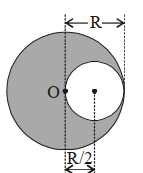
Image

Answer

 If the density of the substance of the sphere is $\rho$, then the mass of the sphere of radius $R$ is $M=\frac{4}{3} \pi R^3 \rho$
The mass of the sphere of radius $\left(\frac{R}{2}\right)$ is
$\begin{aligned}
M_1 & =\frac{4}{3} \pi\left(\frac{R}{2}\right)^3 \rho \\
& =\frac{4}{3} \frac{\pi R^3 \rho}{8}=\frac{M}{8}
\end{aligned}$
The remaining sphere of mass is
$M_2=M-\frac{M}{8}=\frac{7 M}{8}$
If the distance of the center of mass of the reamining sphere from the center of the sphere is $x$, then the center of mass of the complete sphere is taken at the origin O .
$\begin{aligned}
M_1\left(\frac{R}{2}\right)+M_2 x & =0 \\
M_1\left(\frac{R}{2}\right) & =-M_2 x \\
x & =-\frac{M_1}{M_2}\left(\frac{R}{2}\right) \\
& =-\frac{M}{8} \times \frac{8}{7 M}\left(\frac{R}{2}\right) \\
x & =-\frac{R}{14}\quad \text { Ans. }\end{aligned}$ 

Need a full question paper?

Generate a complete, print-ready paper with questions like this in minutes — across 16+ boards, with answer keys.

Start Generating Free

Similar questions

A transverse harmonic wave travelling on a string is described by $\text{y}(\text{x, t}) = 3.0\sin \Big[(36\text{t}+0.018\text{x})+\frac{\pi}{4}\Big]$ where $x$ and $y$ are in $cm$ and $t$ in sec. The positive direction of $x$ is from left to right.
  1. What is its amplitude and frequency?
  2. What is the initial phase at the origin?
  3. What is the least distance between to successive crest in the wave?
Prove that the pressure at a depth h from the free surface of a liquid (P) in a container is $\text{P}=\text{P}_2+\text{h}\rho\text{g},$ where P, is the atmospheric pressure.
Plot the corresponding reference circle for each of the following simple harmonic motions. Indicate the initial (t = 0) position of the particle, the radius of the circle, and the angular speed of the rotating particle. For simplicity, the sense of rotation may be fixed to be anticlockwise in every case: (x is in cm and t is in s).$\text{x}=-2\sin\Big(3\text{t}+\frac{\pi}{3}\Big)$
Four identical cylindrical columns of steel support a big structure of mass $50,000kg$. The inner and outer radii of each column are $30cm$ and $40cm$ respectively. Assuming the load distribution to be uniform, calculate the compressional strain of each column. The Young's modulus of steel is $2.0 \times 10^{11}Pa$.
A woman starts from her home at 8.00 a.m., walks with a speed of 5km/ hr on a straight road upto her office 5km away stays at the office upto 4 p.m., and returns home by an auto with a speed of 25km/ hr. Choose suitable scales, and plot the x-t graph of her motion.
Explain this common observation clearly: If you look out of the window of a fast moving train, the nearby trees, houses etc. seem to move rapidly in a direction opposite to the train’s motion, but the distant objects (hill tops, the Moon, the stars etc.) seem to be stationary. (In fact, since you are aware that you are moving, these distant objects seem to move with you).
Consider a sample of oxygen at 300K. Find the average time taken by a molecule to travel a distance equal to the diameter of the earth.
Calculate the magnetic dipole moment corresponding to the motion of the electron in the ground state of a hydrogen atom.
Find the magnitude and direction of the resultant of two forces $\vec{\text{P}}$ and $\vec{\text{Q}}$ in terms of their magnitudes and angle $\theta$ between them.
Iron emits $\text{K}_\alpha$ X-ray of energy 6.4keV and calcium emits $\text{K}_\alpha$ X-rays of energy 3.69 keV. Calculate the times taken by an iron $\text{K}_\alpha$ photon to cross through a distance of 3km.