MCQ
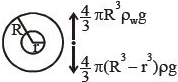
A sphere of solid material of relative density $9$ has a concentric spherical cavity and  floats having just sinked in water. If the radius of the sphere be $R$, then the radius of  the  cavity $(r)$ will be related to $R$ as :-
  • $r^3 = \frac{8}{9} R^3$
  • B
    $r^3 = \frac{2}{3} R^3$
  • C
    $r^3 = \frac{\sqrt 8}{3} R^3$
  • D
    $r^3 = \sqrt { \frac{2}{3}} R^3$

Answer

Correct option: A.
$r^3 = \frac{8}{9} R^3$
a
$\frac{4}{3} \pi\left(\mathrm{R}^{3}-\mathrm{r}^{3}\right) \rho \mathrm{g}=\frac{4}{3} \pi \mathrm{R}^{3} \rho_{\mathrm{w}} \mathrm{g}$

$9\left(R^{3}-r^{3}\right)=R^{3}$

$r^{3}=\frac{8 R^{3}}{9}$

Need a full question paper?

Generate a complete, print-ready paper with questions like this in minutes — across 16+ boards, with answer keys.

Start Generating Free

Similar questions

An observer moves towards a stationary source of sound of frequency $n$. The apparent frequency heard by him is $2n$. If the velocity of sound in air is  $332\, m/sec, $ then the velocity of the observer is .... $m/sec$
The decay constant of a radio active substance is $0.173\, (years)^{-1}.$ Therefore :
For a telescope, focal length of objective lens is $15\, cm$ and focal length of eye piece is $10\, mm .$ If tube length is $16\, cm ,$ then find the magnification
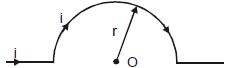
A portion of a conductive wire is bent in the form of a semicircle of radius $r$ as shown below in fig. At the centre of semicircle, the magnetic induction will be
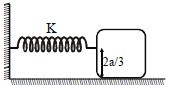
Find maximum amplitude for safe $SHM$ (block does not topple during $SHM$) of $a$ cubical block of side $'a'$ on a smooth horizontal floor as shown in figure (spring is massless)
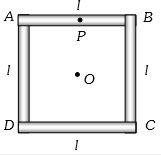
Four thin rods of same mass $M$ and same length $l$, form a square as shown in figure. Moment of inertia of this system about an axis through centre $O$ and perpendicular to its plane is
The pair having the same dimensions is
An ideal gas undergoes an adiabatic process obeying the relation $PV^{4/3} =$ constant. If its initial temperature is $300\,\, K$ and then its pressure is increased upto four times its initial value, then the final temperature is (in Kelvin):
Two particles of masses $1\ kg$  and $3\ kg$ move towards each other under their mutual force of attraction. No other force acts on them. When the relative velocity of approach of the two particles is $2\ m/s,$ their centre of mass has a velocity of $0.5 \ m/s$. When the relative velocity of approach becomes $3\ m/s,$ the velocity of the centre of mass is ........ $m/s$.
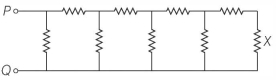
Consider the circuit shown below where all resistors are $1 \,k \Omega$. If a current of magnitude $1 \,mA$ flows through the resistor marked $X$, the potential difference measured between points $P$ and $Q$ are ..............$V$