Question
A spherical ball of salt is dissolving in water in such a manner that the rate of decrease of the volume at any instant is propotional to the surface. Prove that the radius is decreasing at a constant rate.

Answer

We have, rate of decrease of the volume of spherical ball of salt at any instant is surface. Let the radius of the spherical ball of the salt be r.
$\therefore$ Volume of the ball $(\text{V})=\frac{4}{3}\pi\text{r}^3$
and surface area $(\text{S})=4\pi\text{r}^2$
$\because\ \frac{\text{dV}}{\text{dT}}\propto\text{S}$
$\Rightarrow\ \frac{\text{d}}{\text{dt}}\Big(\frac{4}{3}\pi\text{r}^3\Big)\propto4\pi\text{r}^2$
$\Rightarrow\ \frac{4}{3}\pi3\text{r}^2\frac{\text{dr}}{\text{dt}}\propto4\pi\text{r}^2$
$\Rightarrow\ \frac{\text{dr}}{\text{dt}}\propto\frac{4\pi\text{r}^2}{4\pi\text{r}^2}$
$\Rightarrow\ \frac{\text{dr}}{\text{dt}}=\text{k.1}$ [where, k is the proportionality constant]
$\Rightarrow\ \frac{\text{dr}}{\text{dt}}=\text{k}$
Hence, the radius of ball is decreasing at a constant rate.

Need a full question paper?

Generate a complete, print-ready paper with questions like this in minutes — across 16+ boards, with answer keys.

Start Generating Free

Similar questions

A trust fund has $₹ 35000$ that must be invested in two different types of bonds, say $\mathrm{X}$ and $\mathrm{Y}$. The first bond pays $10 \%$ interest p.a. which will be given to an old age home and second one pays $8 \%$ interest p.a. which will be given to WWA (Women Welfare Association). Let A be a $1 \times 2$ matrix and B be a $2 \times 1$ matrix, representing the investment and interest rate on each bond respectively.

Image

(i) Represent the given information in matrix algebra.

(ii) If ₹ 15000 is invested in bond $\mathrm{X}$, then find total amount of interest received on both bonds?

(iii) If the trust fund obtains an annual total interest of ₹ 3200 , then find the investment in two bonds.

OR

If the amount of interest given to old age home is ₹500, then find the amount of investment in bond Y.
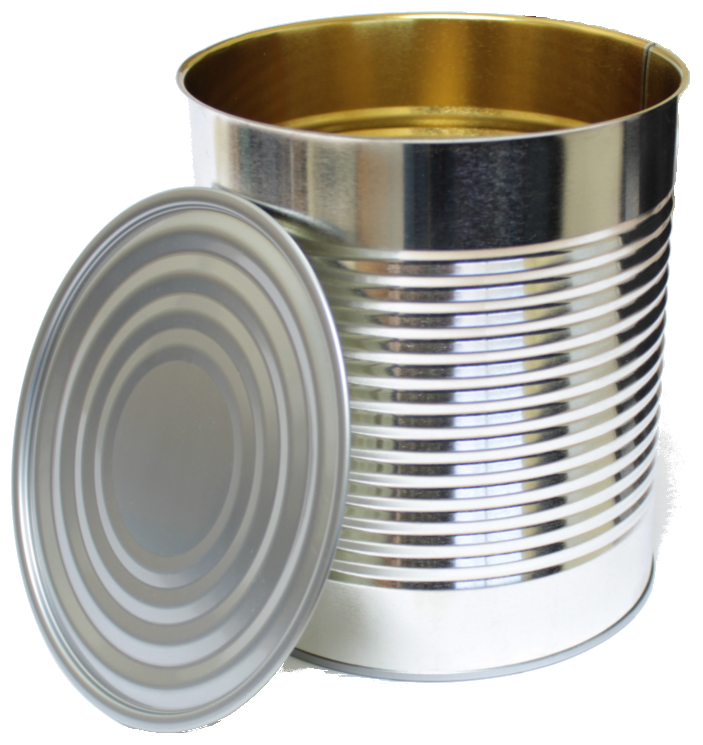
A tin can manufacturer designs a cylindrical tin can for a company making sanitizer and disinfector. The tin can is made to hold 3 litres of sanitizer or disinfector.

Based on the above in formation, answer the following questions.
  1. If r cm be the radius and h cm be the height of the cylindrical tin can, then the surface area expressed as a function of r as.
  1. $2\pi\text{r}^2$
  2. $2\pi\text{r}^2+6000$
  3. $2\pi\text{r}^2+\frac{5000}{\text{r}}$
  4. $2\pi\text{r}^2+\frac{6000}{\text{r}}$
  1. The radius that will minimize the cost of the material to manufacture the tin can is.
  1. $\sqrt[3]{\frac{600}{\pi}}\text{cm}$
  2. $\sqrt{\frac{500}{\pi}}\text{cm}$
  3. $\sqrt[3]{\frac{1500}{\pi}}\text{cm}$
  4. $\sqrt{\frac{1500}{\pi}}\text{cm}$
  1. The height that will minimize the cost of the material to manufacture the tin can is.
  1. $\sqrt[3]{\frac{600}{\pi}}\text{cm}$
  2. $2\sqrt[3]{\frac{1500}{\pi}}\text{cm}$
  3. $\sqrt{\frac{1500}{\pi}}$
  4. $2\sqrt{\frac{1500}{\pi}}$
  1. If the cost of material used to manufacture the tin can is $₹\frac{100}{\text{m}^2}$ and $\sqrt[3]{\frac{1500}{\pi}}\approx7.8,$ then minimum cost is approximately.
  1. ₹ 11.538
  2. ₹ 12
  3. ₹ 13
  4. ₹ 14
  1. To minimize the cost of the material used to manufacture the tin can, we need to minimize the.
  1. Volume.
  2. Curved surface area.
  3. Total surface area.
  4. Surface area of the base.
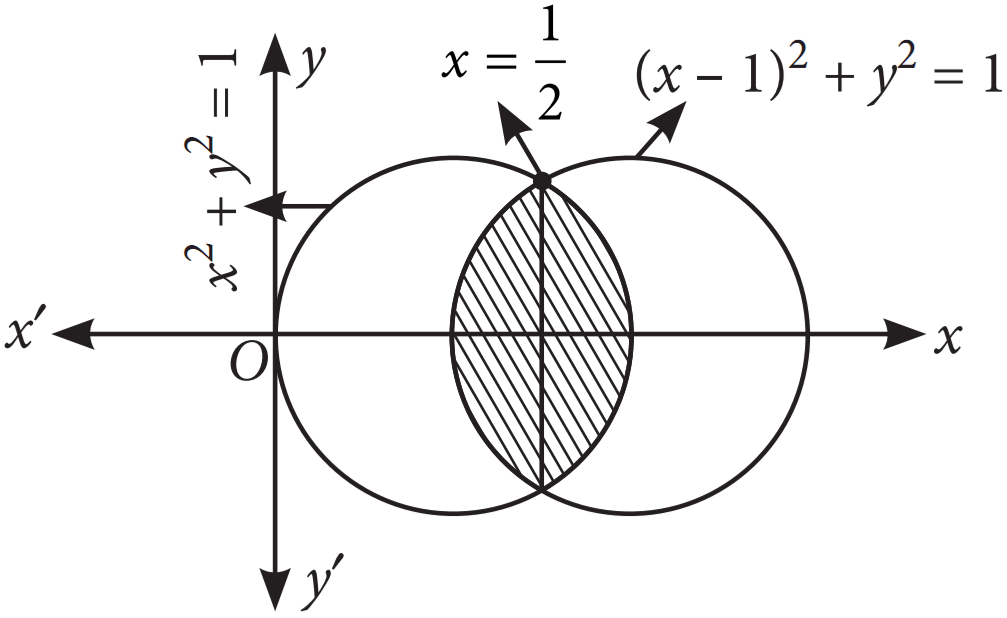
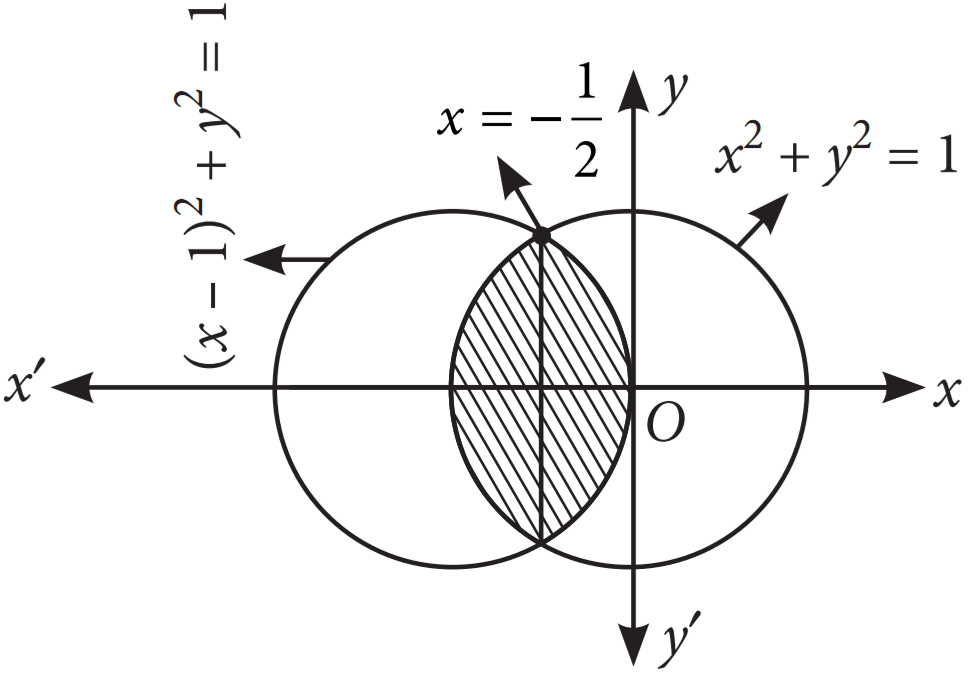
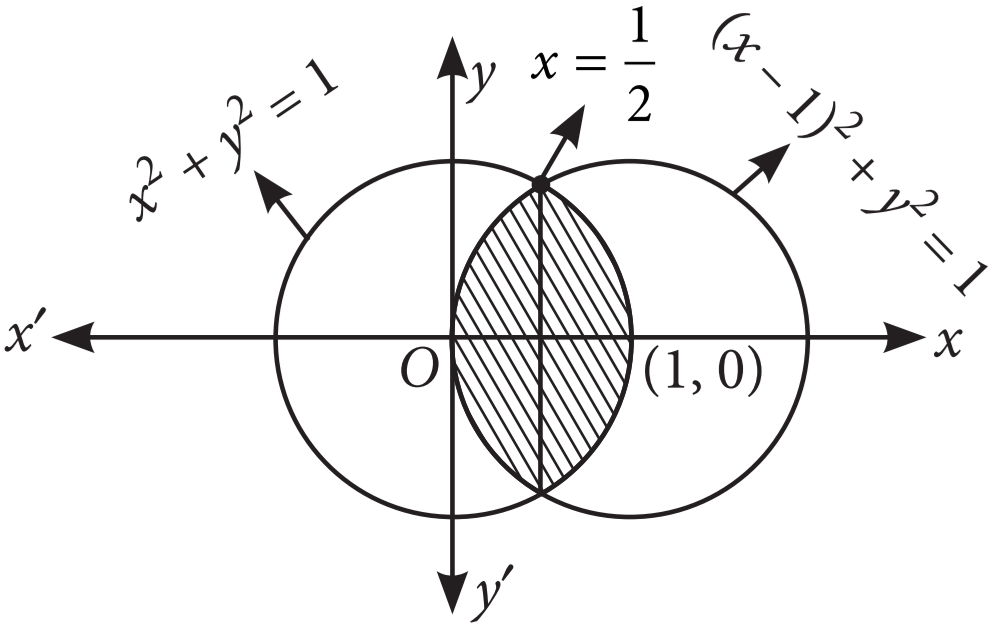
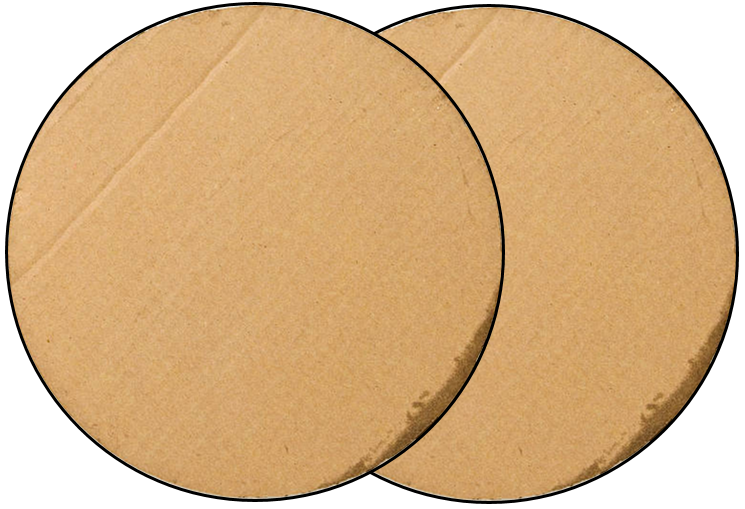
Ajay cut two circular pieces of cardboard and placed one upon other as shown in figure. One of the circle represents the equation (x - 1)2 + y2 = 1, while other circle represents the equation x2 + y2 = 1.

Based on the above information, answer the following questions.
  1. Both the circular pieces of cardboard meet each other at
  1. $\text{x}=1$
  2. $\text{x}=\frac{1}{2}$
  3. $\text{x}=\frac{1}{3}$
  4. $\text{x}=\frac{1}{4}$
  1. Graph of given two curves can be drawn as.
  1. None of these
  1. Value of $\int\limits_{0}^{\frac{1}{2}}\sqrt{1-(\text{x}-1)^2}\text{dx}$ is.
  1. $\frac{\pi}{6}-\frac{\sqrt{3}}{8}$
  2. $\frac{\pi}{6}+\frac{\sqrt{3}}{8}$
  3. $\frac{\pi}{2}+\frac{\sqrt{3}}{4}$
  4. $\frac{\pi}{2}-\frac{\sqrt{3}}{4}$
  1. Value of $\int\limits_{\frac{1}{2}}^{1}\sqrt{1-\text{x}^2}\text{dx}$ is.
  1. $\frac{\pi}{6}+\frac{\sqrt{3}}{4}$
  2. $\frac{\pi}{6}+\frac{\sqrt{3}}{8}$
  3. $\frac{\pi}{6}-\frac{\sqrt{3}}{8}$
  4. $\frac{\pi}{2}-\frac{\sqrt{3}}{4}$
  1. Area of hidden portion of lower circle is.
  1. $\bigg(\frac{2\pi}{3}+\frac{\sqrt{3}}{2}\bigg)\text{ sq.units}$
  2. $\bigg(\frac{\pi}{3}-\frac{\sqrt{3}}{8}\bigg)\text{ sq.units}$
  3. $\bigg(\frac{\pi}{3}+\frac{\sqrt{3}}{8}\bigg)\text{ sq.units}$
  4. $\bigg(\frac{2\pi}{3}-\frac{\sqrt{3}}{2}\bigg)\text{ sq.units}$
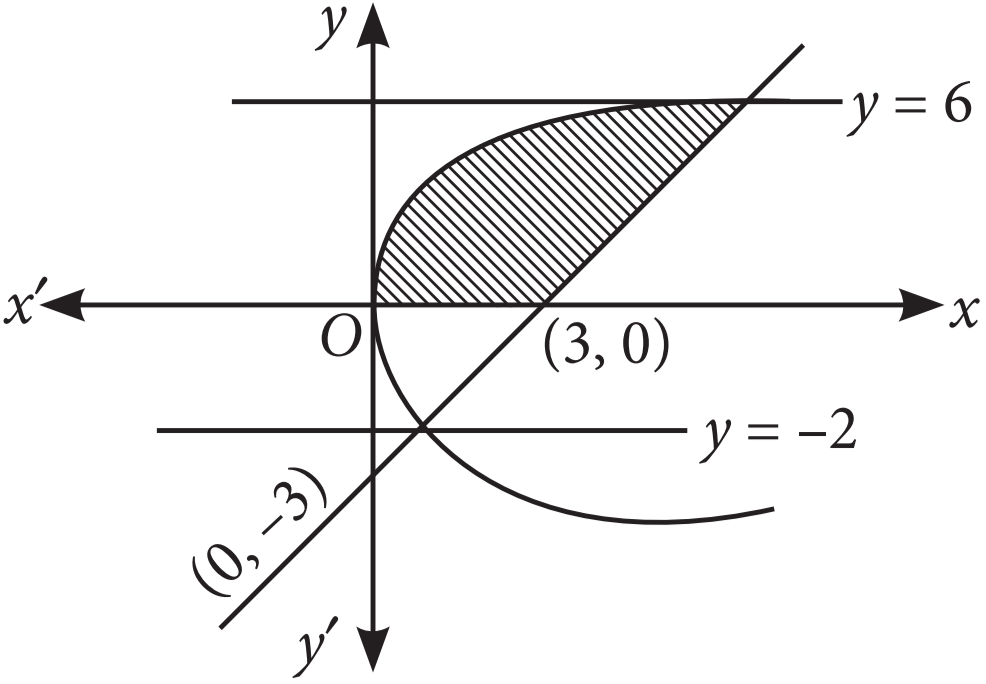
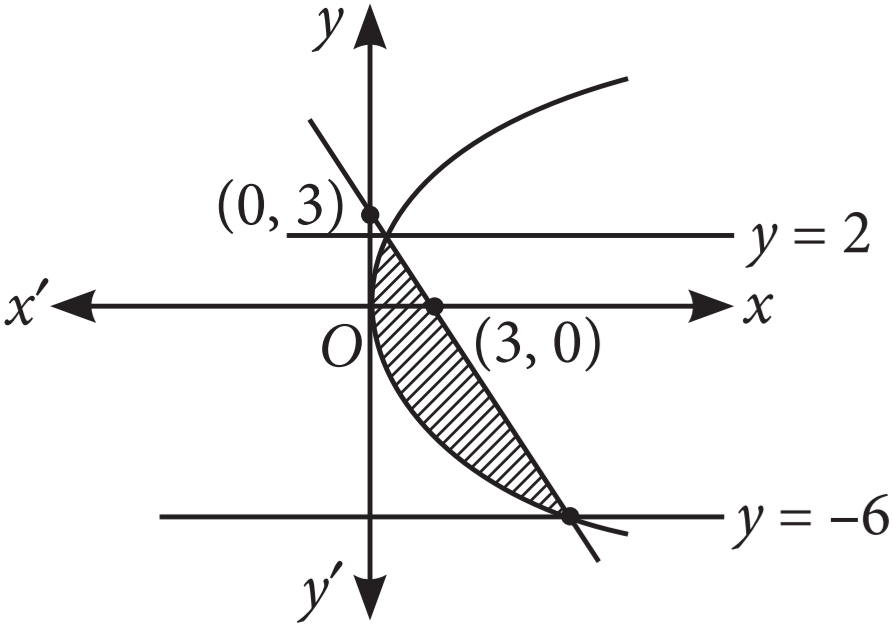
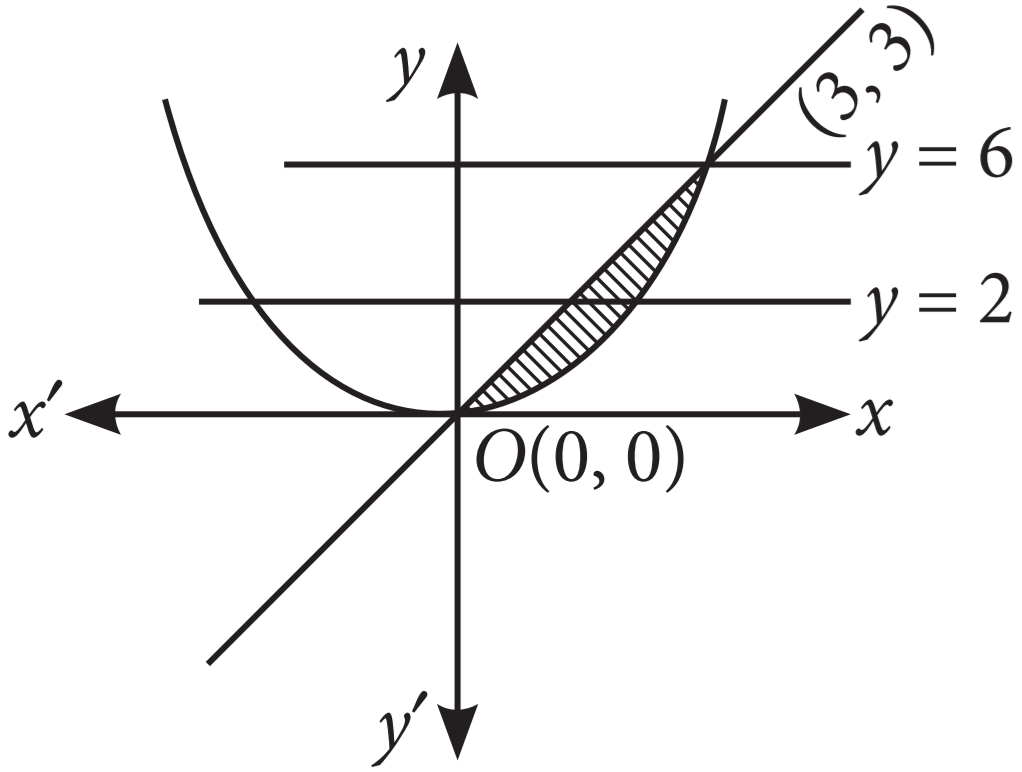
Consider the following equation of curve y2 = 4x and straight line x + y = 3.
Based on the above information, answer the following questions.
  1. The line x + y = 3 cuts the x-axis and y-axis respectively at.
  1. (0, 2), (2, 0)
  2. (3, 3), (0, 0)
  3. (0, 3), (3, 0)
  4. (3, 0), (0, 3)
  1. Point(s) of intersection of two given curves is (are).
  1. (1, -2), (-9, 6)
  2. (2, 1), (-6, 9)
  3. (1, 2), (9, -6)
  4. None of these.
  1. Which of the following shaded portion re present the area bounded by given curves?
    1. None of these
  1. Value of the integral $\int\limits_{-6}^{2}(3-\text{y})\text{ dy}$ is
  1. 10
  2. 20
  3. 30
  4. 40
  1. Value of area bounded by given curves is.
  1. $56\text{ sq.units}$
  2. $\frac{63}{5}\text{ sq. units}$
  3. $\frac{64}{3}\text{ sq. units}$
  4. $31\text{ sq.units}$
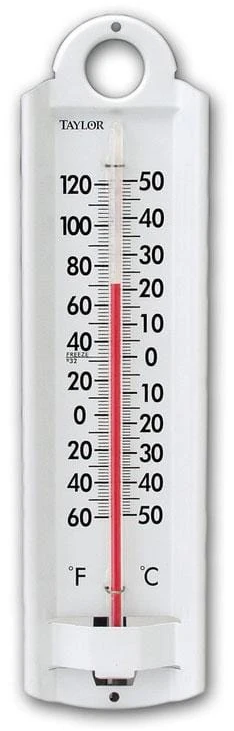
A thermometer reading 80°F is taken outside. Five minutes later the thermometer reads 60°F. After another 5 minutes the thermometer reads 50°F. At any time t the thermometer reading be T°F and the outside temperature be S°F.

Based on the above information, answer the following questions.
  1. If $\lambda$ is posinve constant of propornonality, then $\frac{\text{dn}}{\text{dt}}$ is:
  1. $\lambda(\text{T - S})$
  2. $\lambda(\text{T + S})$
  3. $\lambda\text{T S}$
  4. $-\lambda(\text{T - S})$
  1. The value of T(S) is:
  1. 30°F
  2. 40°F
  3. 5D°F
  4. 60°F
  1. The value of T(10) is:
  1. 50°F
  2. 60°F
  3. 80°F
  4. 90°F
  1. Find the general solution of differential equation fanned in given situation.
  1. $\log\text{T}=\text{St + c}$
  2. $\log(\text{T}-\text{S})=\lambda{\text{t + c}}$
  3. $\log\text{T}=\text{tT + c}$
  4. $\log(\text{T + S})=\lambda{\text{t + c}}$
  1. Find the value of constant of integration c in the solution of differential equation formed in given situation.
  1. $\log(60\ -\ \text{S})$
  2. $\log(80\ +\ \text{S})$
  3. $\log(80\ -\ \text{S})$
  4. $\log(60\ +\ \text{S})$
A company produces three products every day. Their production on certain day is 45 tons. It is found that the production of third product exceeds the production of first product by 8 tons while the total production of first and third product is twice the production of second product.

Using the concepts of matrices and determinants, answer the following questions.
  1. If x, y and z respectively denotes the quantity (in tons) of first, second and third product produced, then which of the following is true?
  1. x + y + z = 45
  2. x + 8 = z
  3. x - 2y + z = 0
  4. All of these.
  1. If $\begin{pmatrix}1&1&1\\1&0&-2\\1&-1&1\end{pmatrix}^{-1}=\frac{1}{6}\begin{pmatrix}2&2&2\\3&0&-3\\1&-2&1\end{pmatrix}$ then the inverse of $\begin{pmatrix}1&1&1\\1&0&-1\\1&-2&1\end{pmatrix}$ is:
  1. $\begin{pmatrix}\frac{1}{3}&\frac{1}{3}&\frac{1}{3}\\\frac{1}{2}&0&\frac{-1}{2}\\\frac{1}{6}&\frac{-1}{3}&\frac{1}{6}\end{pmatrix}$
  2. $\begin{pmatrix}\frac{1}{2}&0&-\frac{1}{2}\\\frac{1}{3}&\frac{1}{3}&\frac{1}{3}\\\frac{1}{6}&\frac{-1}{3}&\frac{1}{6}\end{pmatrix}$
  3. $\begin{pmatrix}\frac{1}{3}&\frac{1}{2}&\frac{1}{6}\\\frac{1}{3}&0&\frac{-1}{3}\\\frac{1}{3}&\frac{-1}{2}&\frac{1}{6}\end{pmatrix}$
  4. None of these.
  1. x : y : z is equal to:
  1. 12 : 13 : 20
  2. 11 : 15 : 19
  3. 15 : 19 : 11
  4. 13 : 12 : 20
  1. Which of the following is not true?
  1. |A| = |A'|
  2. (A')-1 = (A-1)'
  3. A is skew synunetric matrix of odd order, then |A| = 0
  4. |AB| = |A| + |B|
  1. Which of the following is not true in the given determinant of A, where A $=[\text{a}_\text{ij}]_{3\times3}?$
  1. Order of minor is less than order of the det (A).
  2. Minor of an element can never be equal to cofactor of the same element.
  3. Value of a determinant is obtained by multiplying elements of a row or column by corresponding cofactors.
  4. Order of minors and cofactors of same elements of A is same.
Read the following passage and answer the questions given below: elation between the height of the plant $\left(y^{\prime}\right.$ in cm $)$ with respect to its exposure to is governed by the following equation  $y=4 x-\frac{1}{2} x^2$, where ' $x$ ' is the number of days exposed to the sunlight, for $x \leq 3$

Image

(i) Find  the rate of growth of the plant with respect to the number of days exposed to the sunlight.

(ii) Does the rate of  growth of the plant increase or decrease in the first three days? 
What will be the height of the plant after 2 days?
In pre-board examination of class XII, commerce stream with Economics and Mathematics of a particular school, $50 \%$ of the students failed in Economics, 35\% failed in Mathematics and 25\% failed in both Economics and Mathematics. A student is selected at random from the class.

Image

(i) Find the probability that the selected student has failed in Economics, if it is known that he has failed in Mathematics?

(ii) Find the probability that the selected student has failed in Mathematics, if it is known that he has failed in Economics?

A phannaceutical company wants to advertise a new product on T.V., where the product is specially designed for women. For that an advertising executive is hired to study television-viewing habits of married couples during prime time hours. Based on past viewing records he has determined that during prime time husbands are watching television 70% of the time. It has also been determined that when the husband is watching television, 30% of the time the wife is also watching. When the husband is not watching television, 40% of the time the wife is watching television.

Based on the above information, answer the following questions.

  1. The probability that the husband is not watching television during prime time, is:
  1. 0.6

  2. 0.3

  3. 0.4

  4. 0.5

  1. If the wife is watching television, the probability that husband is also watching television, is:
  1. $\frac{2}{11}$

  2. $\frac{7}{11}$

  3. $\frac{5}{11}$

  4. $\frac{8}{11}$

  1. The probability that both husband and wife are watching television during prime time, is:
  1. 0.21

  2. 0.5

  3. 0.3

  4. 0.4

  1. The probability that the wife is watching television during prime time, is:
  1. 024

  2. 0.33

  3. 0.3

  4. 0.4

  1. If the wife is watching television, then the probability that husband is not watching television, is:
  1. $\frac{2}{11}$

  2. $\frac{4}{11}$

  3. $\frac{1}{11}$

  4. $\frac{5}{11}$

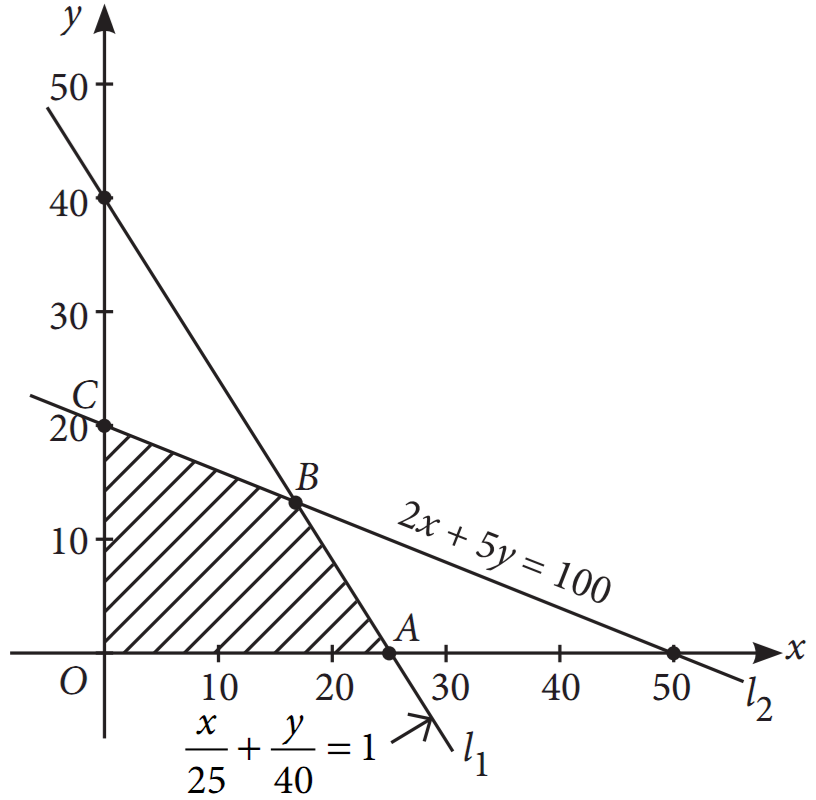
Deepa rides her car at 25 km/ hr. She has to spend ₹ 2 per km on diesel and if she rides it at a faster speed of 40 km/ hr, the diesel cost increases to ₹ 5 per km. She has ₹ 100 to spend on diesel. Let she travels x kms with speed 25 km/ hr and y kms with speed 40 km/ hr. The feasible region for the LPP is shown below:

Based on the above information, answer the following questions.

  1. What is the point of intersection of line l1 and l2?
  1. $\Big(\frac{40}{3},\frac{50}{3}\Big)$

  2. $\Big(\frac{50}{3},\frac{40}{3}\Big)$

  3. $\Big(\frac{-50}{3},\frac{40}{3}\Big)$

  4. $\Big(\frac{-50}{3},\frac{-40}{3}\Big)$

  1. The comer points of the feasible region shown in above graph are:
  1. $(0,25),(20,0),\Big(\frac{40}{3},\frac{50}{3}\Big)$

  2. $(0, 0), (25, 0), (0, 20) $

  3. $(0,0),\Big(\frac{40}{3},\frac{50}{3}\Big),(0,20)$

  4. $(0,0),(25,0),\Big(\frac{50}{3},\frac{40}{3}\Big),(0,20)$

  1. If Z = x + y be the objective function and max Z = 30. The maximum value occurs at point:
  1. $\Big(\frac{50}{3},\frac{40}{3}\Big)$
  2. (0, 0)
  3. (25, 0)
  4. (0, 20)
  1. If Z = 6x - 9y be the objective function, then maximum value of Z is:
  1. -20
  2. 150
  3. 180
  4. 20
  1. If Z = 6x + 3y be the objective function, then what is the minimum value of Z?
  1. 120
  2. 130
  3. 0
  4. 150