Question
A spherical capacitor consists of two concentric spherical conductors, held in position by suitable insulating supports (2.36). Show
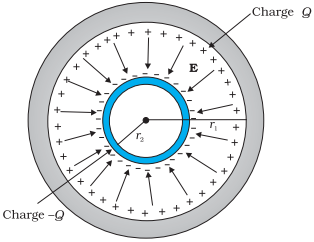
that the capacitance of a spherical capacitor is given by $\text{C}=\frac{{4}\pi\in_{0}\text{r}_1\text{r}_2}{\text{r}_1-\text{r}_2}$ where $r_1$ and $r_2$ are the radii of outer and inner spheres, respectively.
Answer

Radius of the outer shell $= r_1$
Radius of the inner shell $= r_2$​​​​​​​
The inner surface of the outer shell has charge +Q.
$\text{V}=\frac{\text{Q}}{{4}\pi\in_0\text{r}_2}-\frac{Q}{{4}\pi\in_0\text{r}_1}$
The outer surface of the inner shell has induced charge −Q. Potential difference between the two shells is given by,
Where,
$∈_0 =$ Permittivity of free space
$\text{V}=\frac{\text{Q}}{{4}\pi\in_0}\bigg[\frac{1}{\text{r}_2}-\frac{1}{\text{r}_1}\bigg]$
$\text{V}=\frac{\text{Q}(\text{r}_1-\text{r}_2)}{{4}\pi\in_0\text{r}_1\text{r}_2}$
Capacitance of the given system is given by,
$\text{C}\frac{\text{charge}(\text{Q})}{\text{potential difference}(\text{V})}$
$=\frac{{4}\pi\in_0\text{r}_1\text{r}_2}{\text{r}_1-\text{r}_2}$
Hence, proved.

Need a full question paper?

Generate a complete, print-ready paper with questions like this in minutes — across 16+ boards, with answer keys.

Start Generating Free

Similar questions

The normal activity of living carbon-containing matter is found to be about 15 decays per minute for every gram of carbon. This activity arises from the small proportion of radioactive $ ^{14}_6\text{C}$ present with the stable carbon isotope $^{12}_6\text{C}.$ When the organism is dead, its interaction with the atmosphere (which maintains the above equilibrium activity) ceases and its activity begins to drop. From the known half-life (5730 years) of $^{14}_6\text{C },$ and the measured activity, the age of the specimen can be approximately estimated. This is the principle of $^{14}_6\text{C}$ datingused in archaeology. Suppose a specimen from Mohenjodaro gives an activity of 9 decays per minute per gram of carbon. Estimate the approximate age of the Indus-Valley civilisation.
A ball falls on the ground from a height of 2.0m and rebounds up to a height of 1.5m. Find the coefficient of restitution.
A ball is dropped from a height. If it takes 0.200s to cross the last 6.00m before hitting the ground, find the height from which it was dropped. Take $g = 10m/s^2.$
In a typical fission reaction, the nucleus is split into two middle-weight nuclei of unequal masses. Which of the two (heavier or lighter) has greater kinetic energy? Greater linear momentum?
A uniform chain of mass m and length l overhangs a table with its two third part on the table. Find the work to be done by a person to put the hanging part back on the table.
The diameter of the sun is $1.4 \times 10^9m$ and its distance from the earth is $1.5 \times 10^{11}m$. Find the radius of the image of the sun formed by a lens of focal length 20cm.
A charge of $20\mu\text{C}$ is placed on the positive plate of an isolated parallel-plate capacitor of capacitance $10\mu\text{F}.$ Calculate the potential difference developed between the plates.
A metallic rod of length l is rotated at a constant angular speed $\omega , $ normal to a uniform magnetic field B. Derive an expression for the current induced in the rod, if the resistance of the rod is R.
A magnetic field of strength 1.0T is produced by a strong electromagnet in a cylindrical region of radius 4.0cm, as shown in the figure. A wire, carrying a current of 2.0A, is placed perpendicular to and intersecting the axis of the cylindrical region. Find the magnitude of the force acting on the wire.
Obtain the equation of electric current for an AC circuit having only inductor.