MCQ
A spherical charged conductor has surface charge density $\sigma $ . The electric field on its surface is $E$ and electric potential of conductor is $V$ . Now the radius of the sphere is halved keeping the charge to be constant. The new values of electric field and potential would be
  • A
    $2E,\, 2V$
  • $4E,\, 2V$
  • C
    $4E,\, 4V$
  • D
    $2E,\,4V$

Answer

Correct option: B.
$4E,\, 2V$
b
$\mathrm{E}=\frac{1}{4 \pi \varepsilon_{0}} \frac{\mathrm{q}}{\mathrm{R}^{2}}$

As $\mathrm{q}$ is constant, so $E \propto \frac{1}{R^{2}}$

Radius is halved. Therefore, electric field will becomes $4$ times or $4 \mathrm{\,E}.$ 

Further, $\quad \mathrm{V}=\frac{1}{4 \pi \varepsilon_{0}} \frac{\mathrm{q}}{\mathrm{R}}.$

As $\mathrm{q}$ is constant, so $\mathrm{V} \propto \frac{1}{\mathrm{R}}.$

Radius is halved, so potential will becomes two time or $2 \mathrm{\,V}.$

Need a full question paper?

Generate a complete, print-ready paper with questions like this in minutes — across 16+ boards, with answer keys.

Start Generating Free

Similar questions

A hydrogen atom at rest emits a photon during its transition from $n = 2$ to $n = 1$ . Choose the $INCORRECT$ statement.
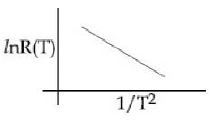
In an experiment, the resistance of a material is plotted as a function of temperature (in some range). As shown in the figure, it is a straight line. One may conclude that:
A block of base $10 \mathrm{~cm} \times 10 \mathrm{~cm}$ and height $15 \mathrm{~cm}$ is kept on an inclined plane. The coefficient of friction between them is $\sqrt{3}$. The inclination $\theta$ of this inclined plane from the horizontal plane is gradually increased from $0^{\circ}$. Then
A rectangular block has a square base measuring $a \times a$ and its height is $h$. It moves on a  horizontal surface in a direction perpendicular to one of the edges.  The coefficient of  friction is $\mu$. It will topple if
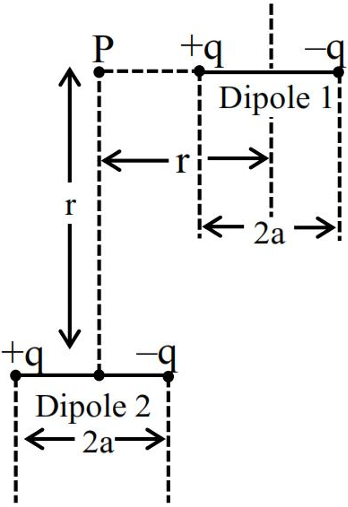
A point particle of charge Q is located at P along the axis of an electric dipole 1 at a distance $r$ as shown in the figure. The point P is also on the equatorial plane of a second electric dipole 2 at a distance $r$. The dipoles are made of opposite charge $q$ separated by a distance 2 a . For the charge particle at P not to experience any net force, which of the following correctly describes the situation ?
Image
Two equal negative charges are fixed at the points $ [0, a ]$ and $[0, -a]$ on the $y-$ axis. A positive charge $Q$ is released from rest at the points $[2a, 0]$ on the $x-$axis . The charge $Q$ will
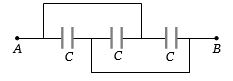
Three equal capacitors, each with capacitance $C$ are connected as shown in figure. Then the equivalent capacitance between $A$ and $B$ is
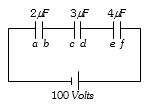
Three capacitors are connected to $D.C.$ source of $100\;volts$ shown in the adjoining figure. If the charge accumulated on plates of ${C_1},\;{C_2}$ and ${C_3}$ are ${q_a},\;{q_b},\;{q_c},{q_d}.{q_e}$ and ${q_f}$ respectively, then
A radio-isotope has a half- life of $5$ years. The fraction of the atoms of this material that would decay in $15$ years will be
In a Young's double slit experiment, the intensities at two points, for the path difference $\frac{\lambda}{4}$ and $\frac{\lambda}{3}$ ( $\lambda$ being the wavelength of light used) are $I_1$ and $I_2$ respectively. If $I_0$ denotes the intensity produced by each one of the individual slits, then $\frac{ I _1+ I _2}{ I _0}=..............$