MCQ
A spherical mirror forms an erect image three times the linear size of the object. If the distance between the object and the image is $80\,cm$, the focal length of the mirror is........
  • A
    $15\;cm$
  • B
    $- 15\;cm$
  • $-30\;cm$
  • D
    $40\;cm$

Answer

Correct option: C.
$-30\;cm$
c
$\mathrm{u}=-\mathrm{x}$

$\mathrm{v}=3 \mathrm{x}$

$3 x+x+80$

$4 x=80 \Rightarrow x=20$

$\mathrm{u}=-20 \quad \mathrm{v}=60$

$\frac{1}{v}+\frac{1}{u}=\frac{1}{f}$

$\frac{1}{60}-\frac{1}{20}=\frac{1}{f}$

$f=-30 \mathrm{\,cm}$

Need a full question paper?

Generate a complete, print-ready paper with questions like this in minutes — across 16+ boards, with answer keys.

Start Generating Free

Similar questions

A scooter is going round a circular road of radius $100 \,m$ at a speed of $10 \,m/s$. The angular speed of the scooter will be ......... $rad/s$
$\frac{x}{x+4}$ is the ratio of energies of photons produced due to transition of an electron of hydrogen atom from its

$(i)$ third permitted energy level to the second level and $(ii)$ the highest permitted energy level to the second permitted level. The value of $x$ will be.
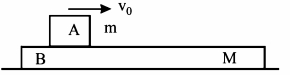
The masses of blocks A and B are $m$ and $M$ respectively. Between $A$ and $B$, there is a constant frictional force $F$ and $B$ can slide on a smooth horizontal surface. A is set in motion with velocity while $B$ is at rest. What is the distance moved by A relative to $B$ before they move with the same velocity?
Assertion : In Young’s experiment, the fringe width for dark fringes is different from that for  white fringes.

Reason : In Young’s double slit experiment the fringes are performed with a source of white light, then only black and bright fringes are observed.

An earth satellite $X$ is revolving around earth in an orbit whose radius is one-fourth of the radius of orbit of a communication satellite. Time period of revolution of $X$ is ..........
The pole pieces of the magnet used in a pivoted coil galvanometer are
A radioactive material has a half life of $10$ days. What fraction of the material would remain after $30$ days
The acceleration of a particle in S.H.M. is
One mole of helium is adiabatically expanded from its initial state $({P_i},{V_i},{T_i})$ to its final state $({P_f},{V_f},{T_f})$. The decrease in the internal energy associated with this expansion is equal to
In a photo-emissive cell, with exciting wavelength $\lambda$ , the maximum kinetic energy of electron is $K$. If the exciting wavelength is changed to $\frac{3\lambda}{4}$ the kinetic energy of the fastest emitted electron will be: