Question
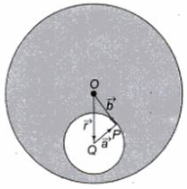
A spherical portion has been removed from a solid sphere having a charge distributed uniformly in its volume as shown in the figure. The electric field inside the emptied space is

Answer

If a Gaussian surface is constructed within the cavity then by Gauss Law $\oint$ E. dS $=0$. This does not mean that $E =0$.

From the image, consider a point $P$ inside the cavity and let $\rho$ be the charge density. Then, after applying superposition principle the net electric field at point $P$ will be:

$E=\frac{\rho}{3 \epsilon_0} \vec{b}-\frac{\rho}{3 \epsilon_0} \vec{a}$

$=\frac{\rho}{3 \epsilon_0} \vec{r} \text { (Since } \vec{r}=\vec{b}-\vec{a} \text { ) }$

which for a given cavity is independent of the position of a point within the cavity.

Therefore, Electric field is non-zero and uniform within the cavity.
Need a full question paper?

Generate a complete, print-ready paper with questions like this in minutes — across 16+ boards, with answer keys.

Start Generating Free

Similar questions

When a spiral spring is stretched by suspending a load on it, the strain produced is called
In a transformer the primary has $500$ turns and secondary has $50$ turns. $100 $ volts are applied to the primary coil, the voltage developed in the secondary will be.....$V$
A particle slides from the top of a smooth hemispherical surface of radius $R$ which is fixed on a horizontal surface. If it separates from the hemisphere at a height $h$ from the horizontal surface, then the speed of the particle is
The energy (E), angular momentum (L), and universal gravitational constant (G) are chosen as fundamental quantities. The dimensions of universal gravitational constant in the dimensional formula of Planck's constant (h) is:
Using the expression $2 d \sin \theta=\lambda$, one calculates the values of $d$ by measuring the corresponding angles $\theta$ in the range $0$ to $90^{\circ}$. The wavelength $\lambda$ is exactly knowns and the error in $\theta$ is constant for all values of $\theta$. As $\theta$ increases from $0^{\circ}$ :
In order to obtain a real image of magnification $2$ using a converging lens of focal length $20 cm,$ where should an object be placed......$cm$
The electric field of an electromagnetic wave in free space is represented as $\vec{E}=E_0 \cos (\omega t-k z) \hat{i}$.The corresponding magnetic induction vector will be :
The fission of $_{235}U$ can be triggered by the absorption of a slow neutrons by a nucleus. Similarly a slow proton can also be used. This statement is
The horizontal acceleration that should be given to a smooth inclined plane of angle $sin^{-1}\, (1/l)$ to keep an object stationary on the plane relative to the inclined plane is
The work function of a substance is $4.0 \,eV$. The longest wavelength of light that can cause photoelectron emission from this substance is approximately ......... $nm$