Question
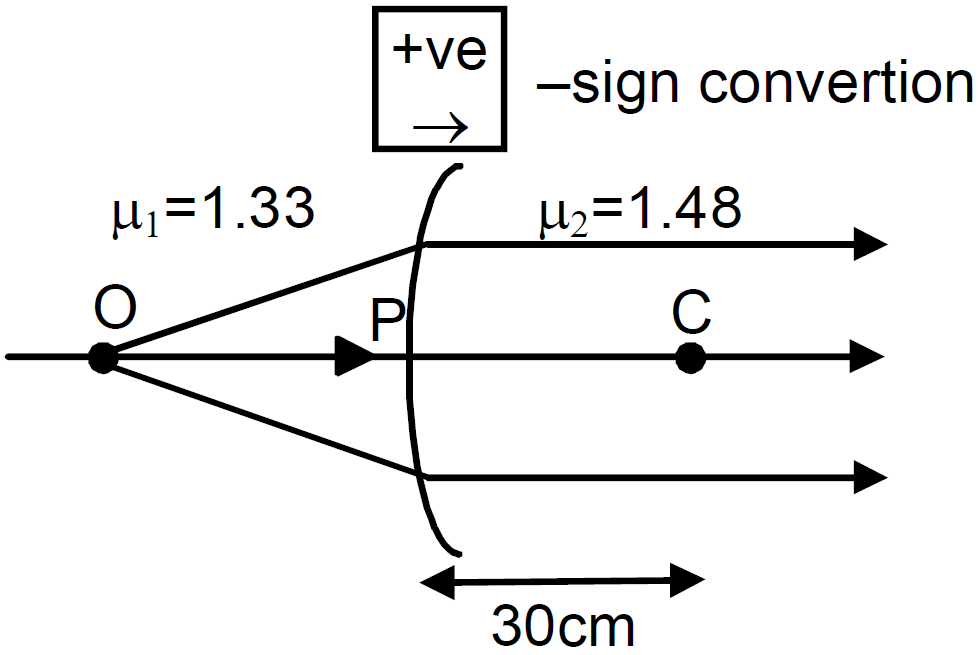
A spherical surface of radius 30cm separates two transparent media A and B with refractive indices 1.33 and 1.48 respectively. The medium A is on the convex side of the surface. Where should a point object be placed in medium A so that the paraxial rays become parallel after refraction at the surface?
Answer

Since, paraxial rays become parallel after refraction i.e. image is formed at $\infty.$$\text{v}=\infty, \ \mu_1=1.33, \ \text{u}=?, \ \mu_2=1.48, \ \text{R}=30\text{cm}$
$\frac{\mu_2}{\text{v}}-\frac{\mu_1}{\text{u}}=\frac{\mu_2-\mu_1}{\text{R}}$
$\Rightarrow\frac{1.48}{\infty}-\frac{1.33}{\text{u}}=\frac{1.48-1.33}{30}\Rightarrow-\frac{1.33}{\text{u}}-\frac{0.15}{30}$
$\Rightarrow\text{u}=-266.0\text{cm}$
$\therefore$ Object should be placed at a distance of 266cm from surface (convex) on side A.

Need a full question paper?

Generate a complete, print-ready paper with questions like this in minutes — across 16+ boards, with answer keys.

Start Generating Free

Similar questions

Calculate the electric flux passing through the spheres $S_1$ and $S_2$ shown in the figure. The linear charge density of the wire $A B$ shown in the figure is $\lambda=K x$ where $x=$ distance from the end $A$ of the wire measured along its length.
Image
Given a uniform electric field$\overrightarrow{\text{E}} : 5\times 10^3 \hat{i}$ N/C, find the flux of this field through a square of l0 cm on a side whose plane is parallel to the y-z plane. What would be the flux through the same square if the plane makes a $30^\circ$ angle with the x-axis?
A man moves on a straight horizontal road with a block of mass 2kg in his hand. If he covers a distance of 40m with an acceleration of $0.5m/s^2$, find the work done by the man on the block during the motion.
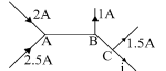
Calculate the value of $i$ as shown in the figure.
Image
The current in the forward bias is known to be more $(\sim\mu\text{A})$ than the current in the reverse bias $(\sim\mu\text{A})$.What is the reason, then, to operate the photodiode in reverse bias?
A test charge q is made to move in the electric field of a point charge Q along two different closed paths Fig. First path has sections along and perpendicular to lines of electric field. Second path is a rectangular loop of the same area as the first loop. How does the work done compare in the two cases?
A parallel beam of monochromatic light of wavelength 663nm is incident on a totally reflecting plane mirror. The angle of incidence is 60° and the number of photons striking the mirror per second is $1.0 × 10^{19}$. Calculate the force exerted by the light beam on the mirror.
The drift current in a p-n junction is $20.0\mu\text{A}.$ Estimate the number of electrons crossing a cross-section per second in the depletion region.
Explain Inductance. Give its unit and dimensions.
Prove that $\varepsilon_0 \mu_0=\frac{1}{c^2}\left(\right.$ or $\left.c=\frac{1}{\sqrt{\varepsilon_0 \mu_0}}\right)$. ###
Derive the relation between the permittivity of free space $\left(\varepsilon_0\right)$, the permeability of free space $\left(\mu_0\right)$ and the speed of light $(c)$.