MCQ
A spherically symmetric charge distribution is characterised by a charge density having the following variations

$\rho (r)\, = \,{\rho _0}\left( {1 - \frac{r}{R}} \right)$ for $r < R$

$\rho (r)\,=\,0$ for $r\, \ge \,R$

Where $r$ is the distance from the centre of the charge distribution $\rho _0$ is a constant. The electric field at an internal point $(r < R)$ is

  • A
    $\frac{{{\rho _0}}}{{4{\varepsilon _0}}}\left( {\frac{r}{3} - \frac{{{r^2}}}{{4R}}} \right)$
  • $\frac{{{\rho _0}}}{{{\varepsilon _0}}}\left( {\frac{r}{3} - \frac{{{r^2}}}{{4R}}} \right)$
  • C
    $\frac{{{\rho _0}}}{{3{\varepsilon _0}}}\left( {\frac{r}{3} - \frac{{{r^2}}}{{4R}}} \right)$
  • D
    $\frac{{{\rho _0}}}{{12{\varepsilon _0}}}\left( {\frac{r}{3} - \frac{{{r^2}}}{{4R}}} \right)$
Answer

Correct option: B.
$\frac{{{\rho _0}}}{{{\varepsilon _0}}}\left( {\frac{r}{3} - \frac{{{r^2}}}{{4R}}} \right)$
b
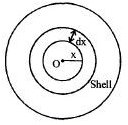
Let us consider a spherical shell of radius $x$ and thickness $dx.$

Charge on this shell

$\mathrm{dq}=\rho 4 \pi \mathrm{x}^{2} \mathrm{dx}=\rho_{0}\left(1-\frac{\mathrm{x}}{\mathrm{R}}\right) .4 \pi \mathrm{x}^{2} \mathrm{dx}$

$\therefore$ Total charge in the spherical region from centre to $r(r < R)$

$q=\int d q=4 \pi \rho_{0} \int_{0}^{T}\left(1-\frac{x}{R}\right) x^{2} d x$

$=4 \pi \rho_{0}\left[\frac{x^{3}}{3}-\frac{x^{4}}{4 R}\right]_{0}^{t}$

$=4 \pi \rho_{0}\left[\frac{r^{3}}{3}-\frac{r^{4}}{4 R}\right]$

$=4 \pi \rho_{0} r^{3}\left[\frac{1}{3}-\frac{r}{4 R}\right]$

$\therefore$ Electric field atr, $\mathrm{E}=\frac{1}{4 \pi \varepsilon_{0}} \cdot \frac{\mathrm{q}}{\mathrm{r}^{2}}$

$ = \frac{1}{{4\pi {\varepsilon _0}}} \cdot \frac{{4\pi {\rho _0}{r^3}}}{{{r^2}}} \cdot \left[ {\frac{1}{3} - \frac{r}{{4R}}} \right]$

$=\frac{\rho_{0}}{\varepsilon_{0}}\left[\frac{\tau}{3}-\frac{\tau^{2}}{4 R}\right]$

Need a full question paper?

Generate a complete, print-ready paper with questions like this in minutes — across 16+ boards, with answer keys.

Start Generating Free

Similar questions

The focal length of the objective and eye piece of a telescope are respectively $60 \,cm$ and $10\, cm$. The magnitude of the magnifying power when the image is formed at infinity is 
A capacitor has capacitance $5 \mu F$ when it's parallel plates are separated by air medium of thickness $d$. A slab of material of dielectric constant $1.5$ having area equal to that of plates but thickness $\frac{ d }{2}$ is inserted between the plates. Capacitance of the capacitor in the presence of slab will be $..........\mu F$
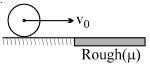
$A$ ring of mass $M$ and radius $R$ sliding with a velocity $v_0$ suddenly enters into rough surface where the coefficient of friction is $\mu$ , as shown in figure.  Choose the correct statement $(s)$
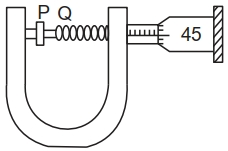
In an experiment to find out the diameter of wire using screw gauge, the following observation were noted.

$(a)$ Screw moves $0.5\,mm$ on main scale in one complete rotation

$(b)$ Total divisions on circular scale $=50$

$(c)$ Main scale reading is $2.5\,mm$

$(d)$ $45^{\text {th }}$ division of circular scale is in the pitch line

$(e)$ Instrument has $0.03 \;mm$ negative error

Then the diameter of wire is $...........\,mm$

A nucleus of lead $Pb _{82}^{214}$ emits two electrons followed by an $\alpha$-particle. The resulting nucleus will have
Given below are two statements: one is labelled as Assertion (A) and the other is labelled as Reason (R).
Assertion (A) : Emission of electrons in photoelectric effect can be suppressed by applying a sufficiently negative electron potential to the photoemissive substance.
Reason (R): A negative electric potential, which stops the emission of electrons from the surface of a photoemissive substance, varies linearly with frequency of incident radiation.
In the light of the above statements, choose the most appropriate answer from the options given below:
A short magnetic needle is pivoted in a uniform magnetic field of strength $1 \,T.$  When another magnetic field of strength $\sqrt 3 \,T$ is applied to the needle in a perpendicular direction, the needle deflects through an angle $\theta$, where $\theta$ is....$^o$
An oil drop having charge $2e$ is kept stationary between two parallel horizontal plates $2.0\, cm$ apart when a potential difference of $12000\, volts$ is applied between them. If the density of oil is $900 \,kg/m^3$, the radius of the drop will be
The time period of a simple pendulum of length $L$ as measured in an elevator descending with acceleration $\frac{g}{3}$ is
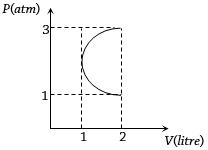
In the $P-V$ diagram shown in figure $ABC$ is a semicircle. The work done in the process $ABC$ is