MCQ
A spring balance and a physical balance are kept in a lift. In these balances equal masses are placed. If now the lift starts moving upwards with constant acceleration, then
  • A
    The reading of spring balance will increase and the equilibrium position of the physical balance will disturb
  • B
    The reading of spring balance will remain unchanged and physical balance will remain in equilibrium
  • C
    The reading of spring balance will decrease and physical balance will remain in equilibrium
  • The reading of spring balance will increase and the physical balance will remain in equilibrium

Answer

Correct option: D.
The reading of spring balance will increase and the physical balance will remain in equilibrium
d
(d) The fictitious force will act downwards. So the reading of spring balance will increase. In case of physical balance, the fictitious force will act on both the pans, so the equilibrium is not affected.

Need a full question paper?

Generate a complete, print-ready paper with questions like this in minutes — across 16+ boards, with answer keys.

Start Generating Free

Similar questions

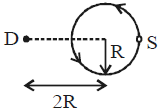
A whistle $S$ of frequency $f$ revolves in a circle of radius $R$ at a constant speed $v$. What is the ratio of largest and smallest frequency detected by a detector $D$ at rest at a distance $2R$ from the centre of circle as shown in figure ? (take $c$ as speed of sound)
A body of mass $(4m)$ is lying in $x-y$ plane at rest. It suddenly explodes into three pieces. Two pieces, each of mass $(m)$ move perpendicular to each other with equal speeds $(v).$ The total kinetic energy generated due to explosion is................. $mv^2$
Which one of the following statements does not hold good when two balls of masses $m _1$ and $m _2$ undergo elastic collision
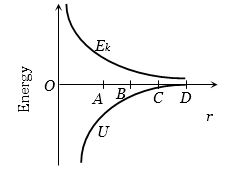
The curves for potential energy $(U)$ and kinetic energy $({E_k})$ of a two particle system are shown in figure. At what points the system will be bound?
Two loops $P$ and $Q$ are made from a uniform wire. The radii of $P$ and $Q$ are ${r_1}$ and ${r_2}$ respectively, and their moments of inertia are ${I_1}$ and ${I_2}$ respectively. If $\frac{{{l_2}}}{{{l_1}}}$ = $4$ then $\frac{{{r_2}}}{{{r_1}}}$ equals
Given that $v$ is the speed, $r$ is radius and $g$ is acceleration due to gravity. Which of the following is dimensionless?
A man stands in front of a hillock and fires a gun. He hears an echo after $1.5\, sec$. The distance of the hillock from the man is ...... $m$ (velocity of sound in air is $330\, m/s$)
A rigid container of negligible heat capacity contains one mole of an ideal gas. The temperature of the gas increases by $1^\circ C$ if $3.0\ \text{cal}$ of heat is added to it. The gas may be:
Given below are two statements: one is labelled as

Assertion $A$ and the other is labelled as Reason $R$.

Assertion $A :$ Earth has atmosphere whereas moon doesn't have any atmosphere.

Reason $R$ : The escape velocity on moon is very small as compared to that on earth.

In the light of the above statement, choose the correct answer from the options given below :

A simple pendulum consisting of a light inextensible string of length $\ell$ attached to a heavy small bob of mass $m$ is at rest. The bob is imparted a horizontal impulsive force which gives it a speed of $\sqrt{4 g \ell}$. The speed of the bob at its highest point is ( $g$ is the accelaration due to gravity)