MCQ
A spring balance is attached to the ceiling of a lift. A man hangs his bag on the spring and the spring reads $49 \,N$, when the lift is stationary. If the lift moves downward with an acceleration of $5\,m/{s^2},$ the reading of the spring balance will be .......... $N$
  • A
    $49$
  • $24 $
  • C
    $74$
  • D
    $15 $

Answer

Correct option: B.
$24 $
b
(b) When the lift is stationary $W = mg$

$⇒$  $49 = m \times 9.8$ $⇒$ $m = 5\,kg.$

When the lift is moving downward with an acceleration $R = m\,(9.8 - a) = 5[9.8 - 5] = 24N$

Need a full question paper?

Generate a complete, print-ready paper with questions like this in minutes — across 16+ boards, with answer keys.

Start Generating Free

Similar questions

A particle is moving unidirectionally on a horizontal plane under the action of a constant power supplying energy source. The displacement $(s)$ - time $(t)$ graph that describes the motion of the particle is (graphs are drawn schematically and are not to scale)
Which of the following is dimensional formula for viscosity?
The breaking stress of a wire depends on:
A particle of mass $M$ moves with constant speed along a circular path of radius $ r$ under the action of a force $F$. Its speed is
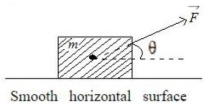
An object of mass ' $m$ ' initially at rest on a smooth horizontal plane starts moving under the action of force $F=2 N$. In the process of its linear motion, the angle $\theta$ (as shown in figure) between the direction of force and horizontal varies as $\theta= kx$, where $k$ is a constant and $x$ is the distance covered by the object from its initial position. The expression of kinetic energy of the object will be $E =\frac{ n }{ k } \sin \theta$. The value of $n$ is $.....$
If $x = a -b,$ then percentage error in $x$ will be
Mark out the correct options.
A spherical body of mass $2\,kg$ starting from rest acquires a kinetic energy of $10000\,J$ at the end of $5^{\text {th }}$ second. The force acted on the body is $.....N$
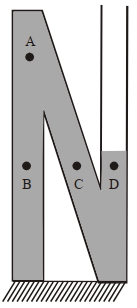
Consider a mercury-filled tube as shown in the figure below 

Which of the following options about the pressures at the lettered locations $(A, B, C, D)$ is true?

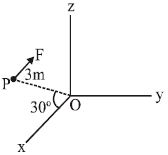
A force $F\, = 2.0\,N$ acts on a particle $P$ in the $xz-$ plane. The force $F$ is parallel to $x-$ axis. The particle $P$ (as shown in the figure) is at a distance $3\,m$ and the line joining $P$ with the origin make angle $30^o$ with the $x-$ axis. The magnitude of torque on $P$ with respect to origin $O(in N-m)$ is